Grooming

Best Brushes for Short-Haired Cats of 2026

A short coat looks like a low-maintenance coat, and that is the trap. Those short, dense hairs are more like needles than fluff — they work their way into the undercoat instead of sitting on top of it, so the cheap brush glides over your cat, collects a polite little halo of fur, and leaves the rest to reappear as a second cat on your black fleece blanket. The right brush pulls that loose undercoat out in a few passes, and your cat actually leans into it instead of leaving in disgust.

I've learned to judge a brush by two things: whether it reaches the skin without scratching, and whether I can clear the fur out of it afterward without picking at it with my fingernails. Over four months, my team and I put 16 brushes through real grooming sessions with short-haired cats, and the gap between the good ones and the ones that just annoyed everybody was wider than I expected. Our cats did a lot of the voting. What follows are the brushes that earned their spot on the shelf — and stayed there.

1

YiEFUR Cat Brush

Top Pick
YiEFUR Cat Brush

Nervous, sensitive cats

Our Score 9.2/10
Check Price

Worth Noting

  • Silicone handle picks up loose fur between sessions
Handle
Soft curved gel
Weight
4.27 oz
Bristles
Soft tip
Cleaning
Self-cleaning button
Read the full review

The handle is the first thing anyone notices — a soft, curved gel that squishes under your fingers and stays put in a damp hand. It's the kind of detail that sounds like marketing until you're several minutes into a session with a cat who keeps rolling over and presenting the other side.

The tips are the other half of the story. These are the softest bristles in the group, and on a short-haired kitten or a cat that flinches at the sight of a brush, that softness is the difference between a session and a standoff. We found it mattered most on the belly and the backs of the legs, where the coat is thinnest. The self-cleaning button does its job: one push and the whole clump slides off.

Where it stops is a dense coat. Soft tips glide over packed undercoat without getting underneath it, so treat this as a finishing and everyday brush rather than a deshedder — for a cat that blows coat twice a year, pair it with an edge tool. At 121 grams it sits comfortably in the hand for as long as the cat will allow.

Bottom line: Our pick for kittens and nervous cats: the softest tips in the group, a gel handle that forgives tired hands, and a button that clears the fur.

2

Glendan Slicker Brush

Glendan Slicker Brush

Face, paws, and belly

Our Score 9.2/10
Check Price

Worth Noting

  • Fur packs into the head and is fiddly to clear
Head
180° rotating
Weight
2.82 oz
Bristles
Coated tips with massage particles
Warranty
12 months
Read the full review

The head on this Glendan is small, noticeably smaller than the slickers above, and that is either the reason to buy it or the reason to skip it. It won't cover a flank in two strokes. It will get under a chin, around a paw, and along the belly of a cat that won't tolerate a full-size brush anywhere near those places.

The rest of the design suits detail work. The head rotates through 180 degrees so you can angle it under a chin without contorting your wrist, the tips are coated and studded with small massage particles, and the whole brush weighs 2.82 ounces. It also carries a 12-month warranty, which is more coverage than most brushes here come with.

It's at its best as a second tool — the one you keep for faces and paws — rather than the only brush in the drawer, and given where it sits at the budget end of this group that's a fair trade. Cats that fidget through a full-body session tend to settle for this one, because the small head never feels like it's covering too much ground at once.

Bottom line: A small-headed slicker for the places a full-size brush can't go — chins, paws, and bellies — with a pivoting head and a warranty behind it.

3

Gonicc De-Shedding Comb

Gonicc De-Shedding Comb

Fine, dense short coats

Our Score 9.2/10
Check Price

Worth Noting

  • Leaves the top coat unsmoothed on its own
Head
2.6-inch stainless steel
Storage
Protective cover and hanging eyelet
Cleaning
Press-button head release
Read the full review

The first pass through a dense short coat tells you what kind of tool this is. The teeth bite, the drag is firm, and you lift away a line of fine grey fur that a slicker had been gliding over without collecting.

It's a comb rather than a brush: 2.6-inch stainless steel teeth, a TPE handle with enough weight to guide your pressure for you, and a button that releases the head entirely so it can be rinsed under a tap. There's a protective cover for storage and an eyelet in the tail if you prefer to hang it.

Where it earns its place is a fine, dense short coat — the kind on a British Shorthair or a Russian Blue, where the undercoat is nearly as fine as the top coat and a pin brush just polishes the surface. It doesn't fluff or smooth anything. This is a stripping tool, and it wants short, gentle strokes rather than long sweeping ones.

What surprised us was the detachable head. Most combs in this style make you dig the fur out of the teeth with your fingers, and this one comes apart in a second and goes back on with a click. If your short-haired cat sheds in visible drifts rather than a light dusting, this is the tool that stops the drifts.

Bottom line: A comb for fine, dense short coats that leave a slicker looking useless — firm teeth, a detachable head, and a light touch required.

4

Swihauk Self-Cleaning Slicker

Swihauk Self-Cleaning Slicker

Thick double coats

Our Score 9.2/10
Check Price

Worth Noting

  • Firm pins are a lot on a thin-coated cat
Bristles
Stainless steel, rounded plastic tips
Cleaning
Press-button retraction
Coat Types
Long and short hair
Read the full review

This is the slicker to look at if your short-haired cat is built more heavily than the average — the ones with a dense double coat that seems to shed all year and then doubles in spring. The pins are stainless steel with rounded plastic caps, set close together, and they work through packed fur instead of skating across the top of it.

Cleaning is where it earns its keep. Press the button and the pins retract into the head, leaving the fur sitting on a smooth surface where it can be wiped away in one motion — no picking, no combing the head out afterwards. That's the mechanism you want on a brush used weekly, and the TPR handle stays grippy even when your hands are covered in fur.

A broad head means fewer strokes to cover a cat, which matters with an animal that grants you about ninety seconds before the tail starts twitching. Down one side, down the other, along the tail, and you're done before the patience runs out.

What we kept coming back to is the combination: enough bite to clear a winter coat and a cleaning action that takes a second. When someone describes a cat that sheds in clumps rather than strands, this is the brush we slide across the table.

Bottom line: The firmest self-cleaning slicker here, and the right one if your short-haired cat carries a thick double coat that shrugs off softer brushes.

5

Hertzko Self-Cleaning Slicker

Hertzko Self-Cleaning Slicker

One-handed daily brushing

Our Score 9.0/10
Check Price

Worth Noting

  • Button needs a firm press and can stick partway
  • Pin tips are firmer than a thin-coated cat may like
Weight
3.2 oz
Bristles
Fine, angled, soft-tip
Cleaning
Push-button retraction
Dimensions
5.8 x 3 x 10 inches
Read the full review

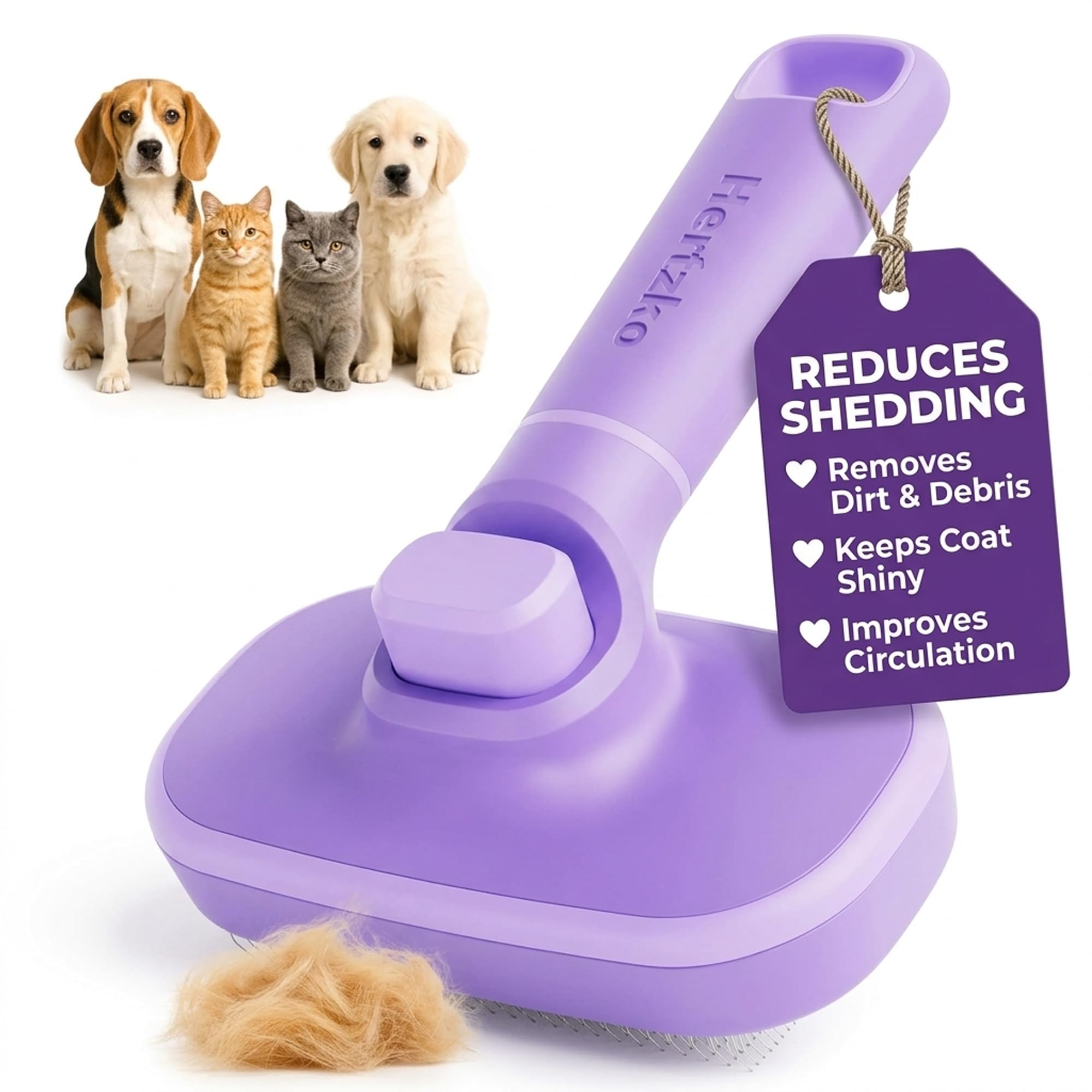
Set this beside our top pick and you're looking at the same idea with a different balance: fine angled pins, a push-button retraction, and a comfort-grip handle, all in a body that weighs 3.2 ounces — the lightest slicker in this group. That lightness is why it stays out on the counter. You can steer it with one hand and hold a cat with the other.

The difference we noticed is the pins. The Hertzko's are finer and a touch firmer than the capped tips on the Aumuca, which is a plus on a coat with some density and a minus on a thin one; with a fine-coated cat we kept the pressure light and the strokes short. A click retracts the pins and leaves the collected fur sitting on top of the head, where it lifts away in one mat.

Bottom line: The lightest slicker we tested, with fine pins that lift short hair fast; keep your strokes shallow on a thin-coated cat.

6

SleekEZ Cat Deshedding Tool

SleekEZ Cat Deshedding Tool

Heavy shedding seasons

Our Score 9.0/10
Check Price

Worth Noting

  • Strips undercoat but doesn't smooth the top coat
Weight
2 oz
Tool Type
Serrated deshedding edge
Coat Types
Short, medium, and long
Dimensions
5.5 x 3 x 1.5 inches
Read the full review

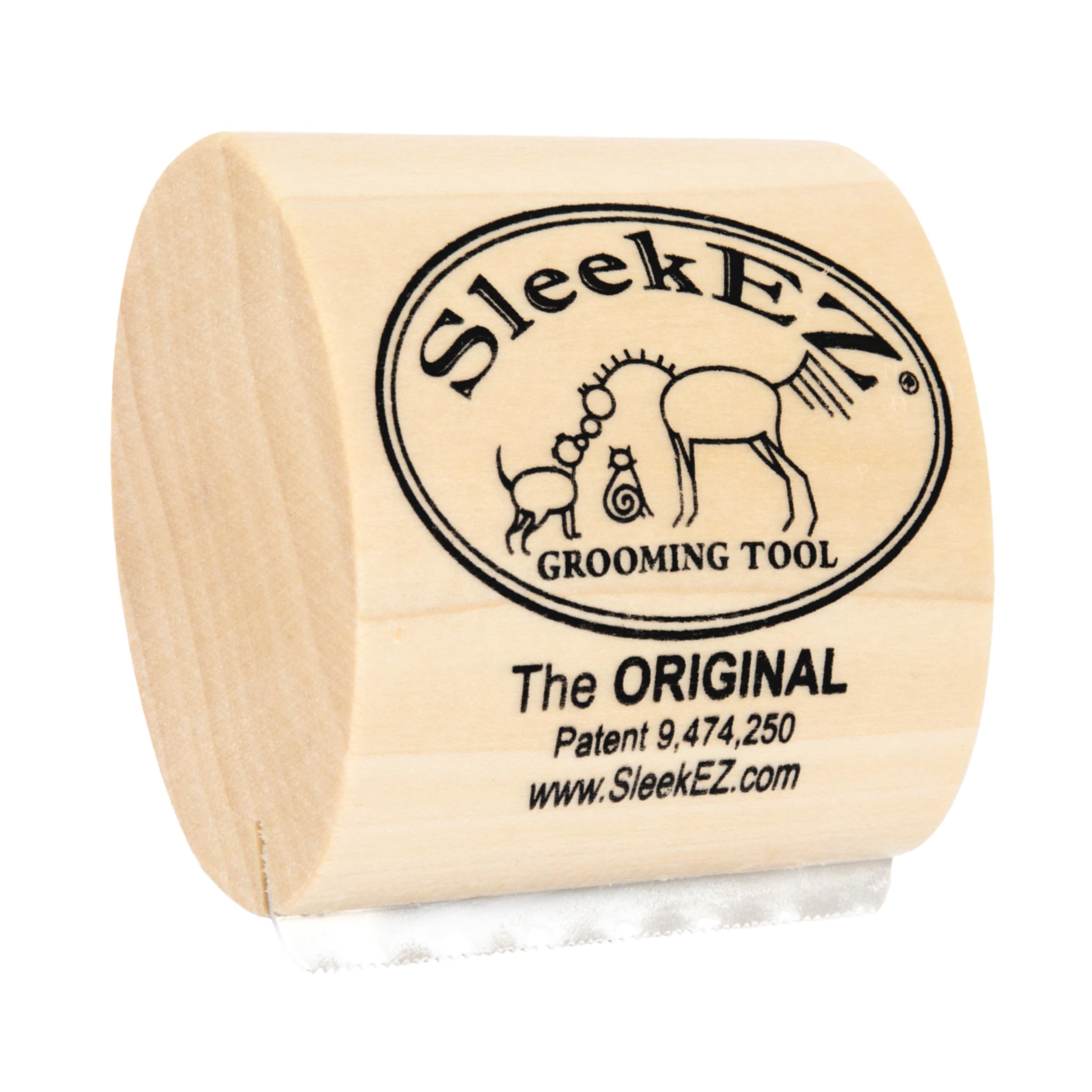
There are no pins on this one. The SleekEZ is a small blade with a serrated edge that you hold flat against the coat, and it does a different job from every slicker here: instead of lifting surface hair, it drags the loose undercoat out from underneath it.

You work in short, light strokes in the direction the coat grows, one section at a time. What comes up is the grey, dense stuff a pin brush skates over — the fur that ends up in the vacuum and on the dark jeans in the closet. On a short coat the effect shows fast: a couple of minutes down the back and the coat sits flatter and looks glossier at the same time.

Pressure is the thing to get right. The edge sits directly on the skin, so the weight of your hand matters more than it does with a brush. We kept the strokes feather-light, let the serrations do the work, and stopped when the coat stopped giving. Cats with a fine, close coat took to it; a cat that objects to being handled at all is a harder sell, because the tool only works when it lies flat.

Two ounces and a five-and-a-half-inch body make it easy to keep control around the shoulders and hindquarters, where a cat is most likely to complain. And the edge earns its place away from the cat entirely: drawn across a cat bed, a tree, or a car seat, it pulls embedded hair up in strips. Ours lives in the cupboard with the vacuum rather than in the grooming box.

Bottom line: The deshedding tool we keep for coat-blowing season: a light edge that lifts short undercoat a slicker leaves behind, as long as you don't press.

7

Depets Cat Brush

Depets Cat Brush

Budget-conscious households

Our Score 9.0/10
Check Price

Worth Noting

  • Soft pins need extra passes on a dense coat
Weight
4.16 oz
Bristles
60° angled, rounded beads
Cleaning
One-click release button
Read the full review

The Depets is the least expensive cat-specific brush we're recommending, and nothing about it reads as a corner cut. It weighs 4.16 ounces with a non-slip handle, the pins are stainless steel set at a 60-degree angle, and each one ends in a small rounded bead rather than a cut tip.

The angle matters more than it sounds on a short coat: the pins meet the hair at a shallower pitch, so they comb through the top layer instead of digging at it. The release is a one-click push, and the fur comes away in a pad rather than in wisps you have to chase off the pins.

What you give up is bite. These are the softest pins of the cat-specific brushes here, and on a thick double coat you'll be making several passes where a firmer brush takes one. On an ordinary short coat that's a good trade — the gentleness is why a fussy cat sits through it — and at the budget end of this group it's the easiest recommendation on the page.

Bottom line: The cheapest cat-specific brush here, and still gentle: rounded beads, a shallow pin angle, and a release button that works.

8

Aumuca Cat Brush

Aumuca Cat Brush

Everyday short-coat grooming

Our Score 8.8/10
Check Price

Worth Noting

  • Pricier than the budget cat brushes here
Weight
5.6 oz
Cleaning
One-click shutter release
Bristle Tips
Rounded rubber tips
Bristle Material
304 stainless steel
Read the full review

The pins on this brush end in rounded rubber tips, and on a short-haired cat that one detail is what settles it for us. A short coat leaves very little fur between the pin and the skin, so a bare metal end is felt directly along the spine and ribs. The Aumuca's 150-degree bent needles are capped, and we could work down the back and along the legs without the flinch a sharper brush earns.

The pins are 304 stainless steel, a little thicker than the wire on a typical slicker, and they sit in a round head that sweeps a flank in two or three strokes. Cleaning is the good part: a click sends a shutter up behind the pins and the collected fur lifts off in one piece, so you're not digging at it with your fingers between passes.

At 5.6 ounces it's heavier than the lightest slicker here but steady in the hand, and the handle is shaped so a full session doesn't leave your wrist complaining. Cats tend to read the capped tips as a massage — the ones that usually walk off halfway through stayed put for us.

What you're paying for is the tip finishing and the shutter, and it costs more than the budget cat brushes here. If your cat carries a dense undercoat that comes out in sheets, this isn't the only tool you'll want; a deshedding edge does that job faster. For the everyday pass that keeps fine hair off the sofa, it's the one we reach for first.

Bottom line: Our pick for most short-haired cats: capped pins that don't scrape a thin coat, a head that covers ground fast, and a shutter that clears the fur in one push.

How We Tested the Best Brushes for Short-Haired Cats

We started by gathering every brush that comes up in short-haired cat conversations — slickers, rubber curry combs, grooming gloves, fine-toothed deshedding tools — then narrowed the field by bristle type, handle shape, price, and the pattern of complaints in customer reviews. Sixteen brushes made the cut. Each one went home with a short-haired cat and its person for four months, which carried us straight through a seasonal coat blowout.

Every brush got used the way brushes actually get used: a few minutes on the couch during the evening, a longer Sunday session on the bathroom floor, a quick pass after a vet visit when the carrier stress had the fur flying. To compare hair removal without guessing, we pressed the collected fur from each session into a ball and weighed it, then checked how much was left behind by running a damp hand over the cat afterward. For ease of cleaning, we noted whether the fur peeled off the bristles in one sheet or clung on and had to be pulled out strand by strand. Ease of use came down to simple things — how the handle sat in the hand, whether a ten-minute session left a sore wrist, and whether the cat stayed put past the first minute or walked off mid-stroke.

On self-cleaning models we pressed the retract button after every session and recorded whether it fired on the first push, felt stiff, or jammed once fur packed into the mechanism. At the end of four months we inspected each brush for bent or rusted teeth, cracked plastic, loose heads, and handles that had started to separate, and we factored in how the cats responded once the novelty wore off. The brushes that held up were the ones where the button still worked cleanly and the cat still showed up.

How to Choose Brushes for Short-Haired Cats

Check the tips before anything else

On a long-haired cat a pin travels through inches of coat before it reaches skin. On a short-haired one it is almost touching, so the finish on the tip is the whole game. Capped, rounded, or bead-tipped pins glide; cut metal ends drag. We check every brush the way you can in a shop: press a pin lightly into the inside of your wrist. If it dents, it will dent a cat.

Pins that are too soft bring their own problem — they skate over a dense undercoat and leave the loose hair where it was. Look for pins with some spring that still end in a cap.

Match the tool to the job, not the season

A slicker lifts surface hair and is the everyday tool. A serrated deshedding edge gets underneath and pulls loose undercoat out. A fine-toothed comb is for the dense short coats that defeat both. Most short-haired cats do well with one good slicker and nothing else.

The common mistake is buying a deshedding blade as a first brush. It strips rather than smooths, it doesn't fluff a coat, and it punishes a heavy hand — useful as a second tool in spring, frustrating as the only one you own.

What a self-cleaning button is actually worth

Retracting pins are the difference between a brush you use weekly and one you avoid, but the mechanism varies a lot. The good ones push the collected fur onto a flat surface where it lifts off whole. The poor ones leave a plug of hair wedged in the head that you end up picking out with your fingers anyway.

Look at a side-on photo of the head before you order and see where the fur goes when the button is pressed. And expect to wipe the head down — self-cleaning means the pins release the hair, not that the brush stays spotless.

Head size, weight, and one hand

A broad head covers a cat's back and flanks in a couple of passes, which matters with an animal that grants you a minute. A small head isn't a lesser brush — it's the one that gets under a chin or around a paw, and it's worth having if your cat is sensitive about the front end.

Weight matters as much. Around three ounces steers easily one-handed while the other hand keeps a cat in place; a heavier brush gives more control through a dense coat. If you have both a bold cat and a nervous one, that's an argument for two brushes rather than a bigger one.

Frequently Asked Questions

Final Verdict

The Aumuca is the brush we point most people with a short-haired cat toward. The capped pins are the reason: on a coat with almost no padding, the finish on the tip decides whether a cat sits through a session, and the one-click shutter means you'll actually use it instead of leaving it in a drawer.

If your cat sheds in drifts rather than strands, add the SleekEZ and run it over the coat before the slicker. If you want to spend as little as possible and still get a gentle, working brush, the Depets does that job without feeling like a compromise.