Grooming

Best Brushes for Long-Haired Cats of 2026

A long-haired cat sprawled in a sunbeam looks like the easiest animal alive to brush — until the brush hits a knot behind an ear and the session ends with a yowl and a mouthful of fur. The problem usually isn't the cat but the tool: pins too short to reach the undercoat, tips too sharp to be tolerated, bristles set so tightly that every stroke tugs. Get it right and grooming becomes something your cat leans into; get it wrong and you're vacuuming the sofa twice a day.

My own long-haired cat has opinions, and my team and I have now put 14 brushes in front of her over three months of daily sessions. Nobody tells a first-time fluffy-cat owner that the topcoat is a decoy; what counts is whether the pins reach the dense undercoat without scraping skin, and whether the brush gives that fur back easily when you clean it. The picks below are the ones she stopped walking away from.

1

Cafhelp 2-Pack Stainless Combs

Top Pick
Cafhelp 2-Pack Stainless Combs

Finishing and coat checks

Our Score 9.4/10
Check Price

Worth Noting

  • Won't lift a dense undercoat by itself
Combs
7.4 in and 6.3 in
Teeth
Rounded stainless steel
Set Weight
3.84 oz
In The Pack
Two combs
Read the full review

A comb answers the question a brush can't: whether you're finished. Draw it through the coat after a slicker and anything still hiding at skin level catches on the teeth straight away. This pair covers both ends of that job — a 7.4-inch comb for the body and a 6.3-inch one for faces, legs, and the ruff — and it's the set we hand to anyone who already owns a brush and still keeps finding mats.

The teeth are stainless with rounded ends, which matters more on a cat than it sounds. A comb is the tool that goes closest to the skin, around the ears and under the chin, and a sharp-ended one ends the session in a hurry. Rounded ends glide, and steel doesn't build the static a plastic comb does on a dry winter coat.

The two sizes solve a practical problem as well: the short comb drops into a pocket or a travel bag, so it's the one that comes out at the vet or on a cat who'll only tolerate one small area at a time. The pair weighs under four ounces, which is why it ends up in a drawer rather than a cupboard and actually gets used.

Bottom line: The set we hand to anyone who already owns a brush: two rounded stainless combs that find the mats a slicker skims over, at the lowest price here.

2

Augwind 3-Piece Grooming Kit

Augwind 3-Piece Grooming Kit

First grooming kit

Our Score 9.4/10
Check Price

Worth Noting

  • Slicker is the plainest of the three tools
Tools
Slicker, rake, flea comb
Warranty
2 years
Rake Teeth
9 and 17, double-sided
Set Weight
12.7 oz
Read the full review

Three handles arrive in one box: a self-cleaning slicker, a double-sided rake with nine teeth on one side and seventeen on the other, and a fine-toothed flea comb, all backed by a two-year warranty. If you're starting from nothing with a long-haired cat, that's most of a kit in a single purchase.

The rake is the piece that justifies the set. It's the same double-sided arrangement as our dedicated mat pick, and it does the job a slicker can't: getting under a mat and clearing the loose undercoat that gathers along the spine. Between the two rake sides and a working slicker, a weekly routine is covered.

The flea comb earns its place more quietly. Fine teeth reach the chin, cheeks, and the short fur on the face where nothing else fits, and it's the tool for working out whether the dark specks in a coat are dirt or something with legs. It isn't a treatment for fleas; it's how you find out whether you have a problem worth solving.

So the set suits two buyers: someone building a first grooming kit around a long-haired cat, and a house with a cat and a dog where one box has to cover both. If you already own a good slicker, buy the rake on its own and put the difference toward a stainless comb.

Bottom line: We like this as a first kit: the double-sided rake does the real work, and the slicker and flea comb cover the rest of a weekly routine.

3

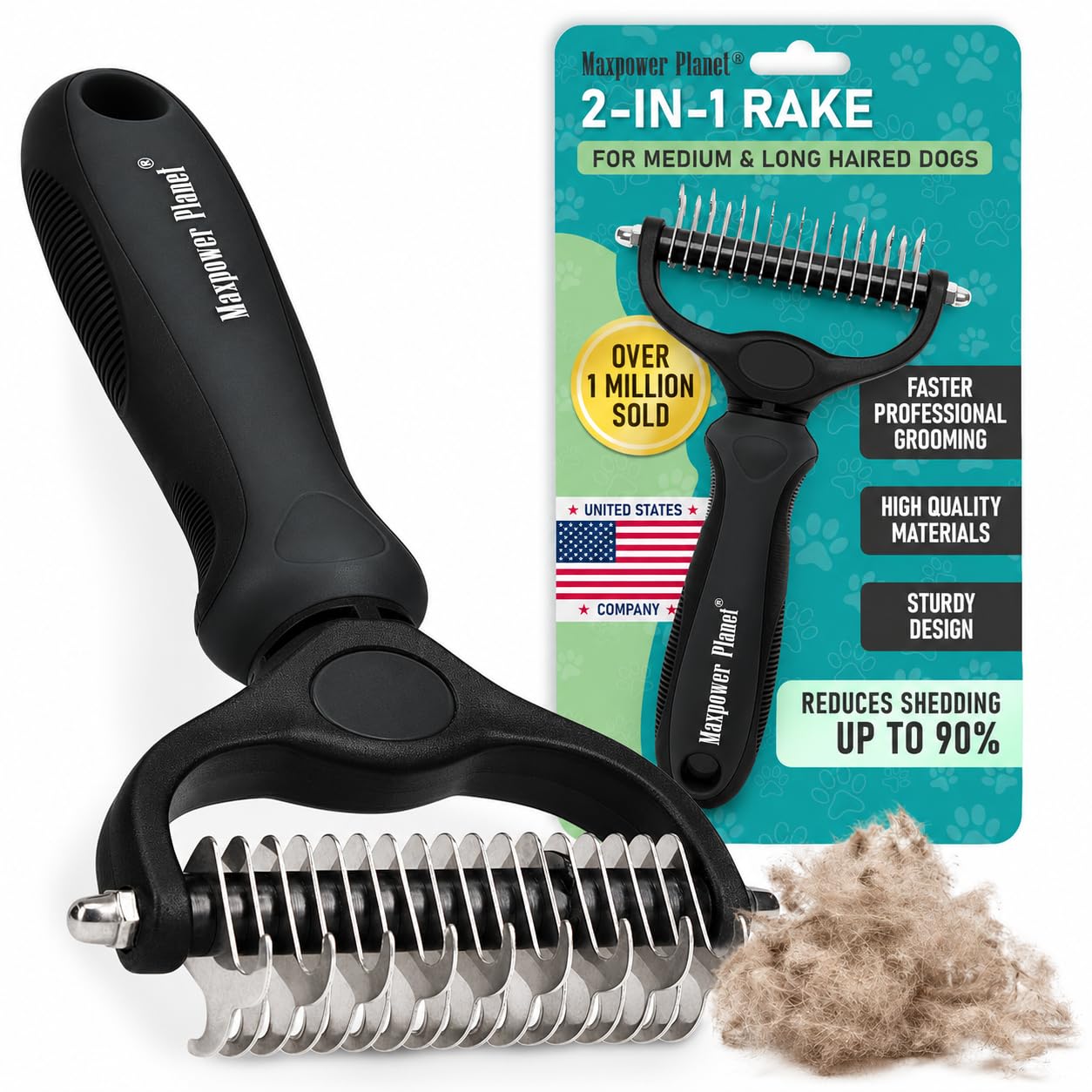
Maxpower Planet Undercoat Rake

Maxpower Planet Undercoat Rake

Mats and tangles

Our Score 9.2/10
Check Price

Worth Noting

  • Wide side can tug on fine, sparse coats
Teeth
9 and 17, double-sided
Handle
Non-slip rubber
Weight
4.59 oz
Head Size
6.6 x 3.9 in
Read the full review

A mat behind the ear or under a front leg isn't a tangle, and no brush in this guide will undo one by brushing harder at it. What works is teeth with space between them: this rake carries nine on one side for the mat itself and seventeen on the other for the loose undercoat around it, all with rounded ends.

Technique does most of the work. Pinch the mat between two fingers so you can feel the skin underneath, take the nine-tooth side to the outer edge in short strokes, and work inward a little at a time. It's a job for several short sessions rather than one long one — hauling a whole mat out in a single pass is how a cat learns to hate the sight of a grooming tool.

For a long-haired cat who felts at the armpits every spring, this is what keeps the clippers out of the picture, and it's the tool we keep by the sofa rather than in the grooming box. It isn't a daily brush; it comes out when you find something, and the rest of the week belongs to a slicker and a comb. The rubber handle is the small thing that makes a difference when your hands are already holding a cat.

Bottom line: The tool we reach for once a mat has formed: nine rounded teeth on one side to work it loose, seventeen on the other to clear the undercoat around it.

4

YiEFUR Cat Brush

YiEFUR Cat Brush

Sensitive cats, sore hands

Our Score 9.2/10
Check Price

Worth Noting

  • Silicone handle collects loose fur
Handle
Silicone gel
Weight
4.3 oz
Cleaning
Push-button release
Pin Type
Soft-tip pins
Read the full review

The handle is the reason to look at this one: a soft silicone gel grip that gives under your fingers and stays put when the cat shifts. If a brushing session leaves your hand aching, that shape is the fix, and this is the least expensive gel handle in the group.

The bristles are soft-tipped too, which puts it in the same gentle camp as the Depets: good for a cat who objects to scratchy pins, and best on a coat that doesn't need heavy undercoat work.

The button does what it promises. One press and the fur slides off the pins in a pad rather than in wisps, which is the difference between a brush you use daily and one you avoid because clearing it is a chore.

Where it earns its place is comfort — yours. For sore hands, small hands, or a cat who needs brushing in short bursts through the week, the grip is what keeps the habit going, and the oval head at 4.3 ounces works around shoulders and chest without much steering.

Bottom line: We pick this one for the grip — a soft gel handle that keeps a long session easy on sore hands, with pins gentle enough for a fussy cat.

5

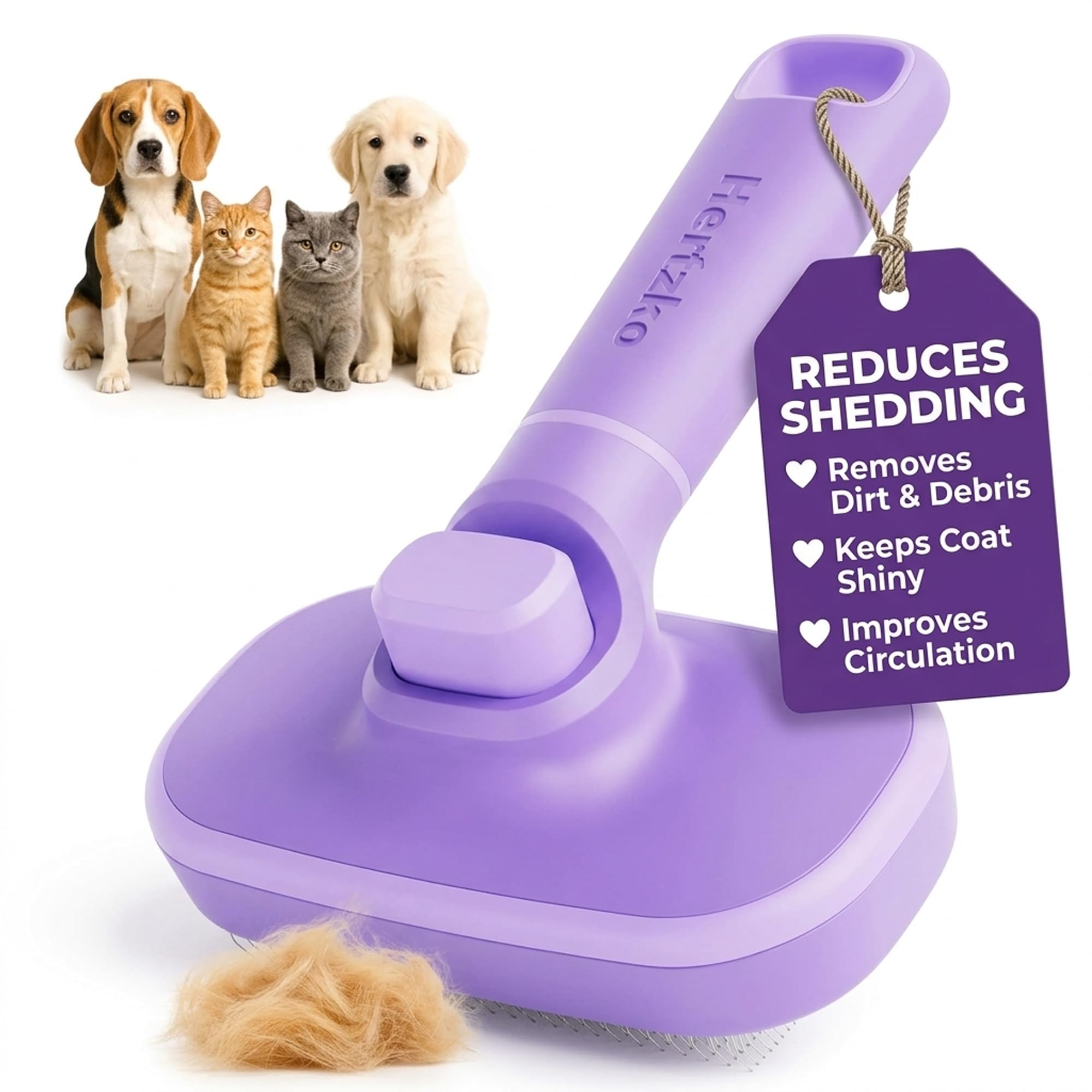
Hertzko Self Cleaning Slicker

Hertzko Self Cleaning Slicker

Large cats, dense coats

Our Score 9.0/10
Check Price

Worth Noting

  • Retract button can stick and need working loose
Weight
3.2 oz
Cleaning
Push-button retraction
Pin Type
Angled fine pins
Head Size
5.8 x 3 in
Read the full review

Think of this as the same idea as our top pick built for a bigger animal: a head nearly six inches across, firmer pins, and a push-button that retracts the whole pin bed. On a large cat with a dense double coat, the extra width means fewer passes over the same flank. On a small, fine-boned cat it's a lot of brush, and you'll spend more time steering it than using it.

Where it earns its spot is the coat that shrugs off gentler tools. The pins are longer and stiffer than the capped ones on the Aumuca, so they part a thick winter coat rather than riding over it, and one press leaves the fur sitting on top of the head ready to be lifted off in a sheet. For a big cat in a cold house, this is the one we reach for first.

The pins also have more point to them, which is why they work through a heavy coat and why we keep them moving rather than pressing — short strokes along the spine and hips, and a wider berth around the tail and the thin skin inside the back legs. That's technique rather than a design flaw, and a cat who is touchy about being handled near the rear is easier to work in small sections with a comb. The 3.2-ounce body is light enough that a ten-minute session doesn't wear out a wrist.

Bottom line: We keep this one for big cats in heavy coats — the wide head and stiffer pins cover a large flank fast, and one press drops the fur.

6

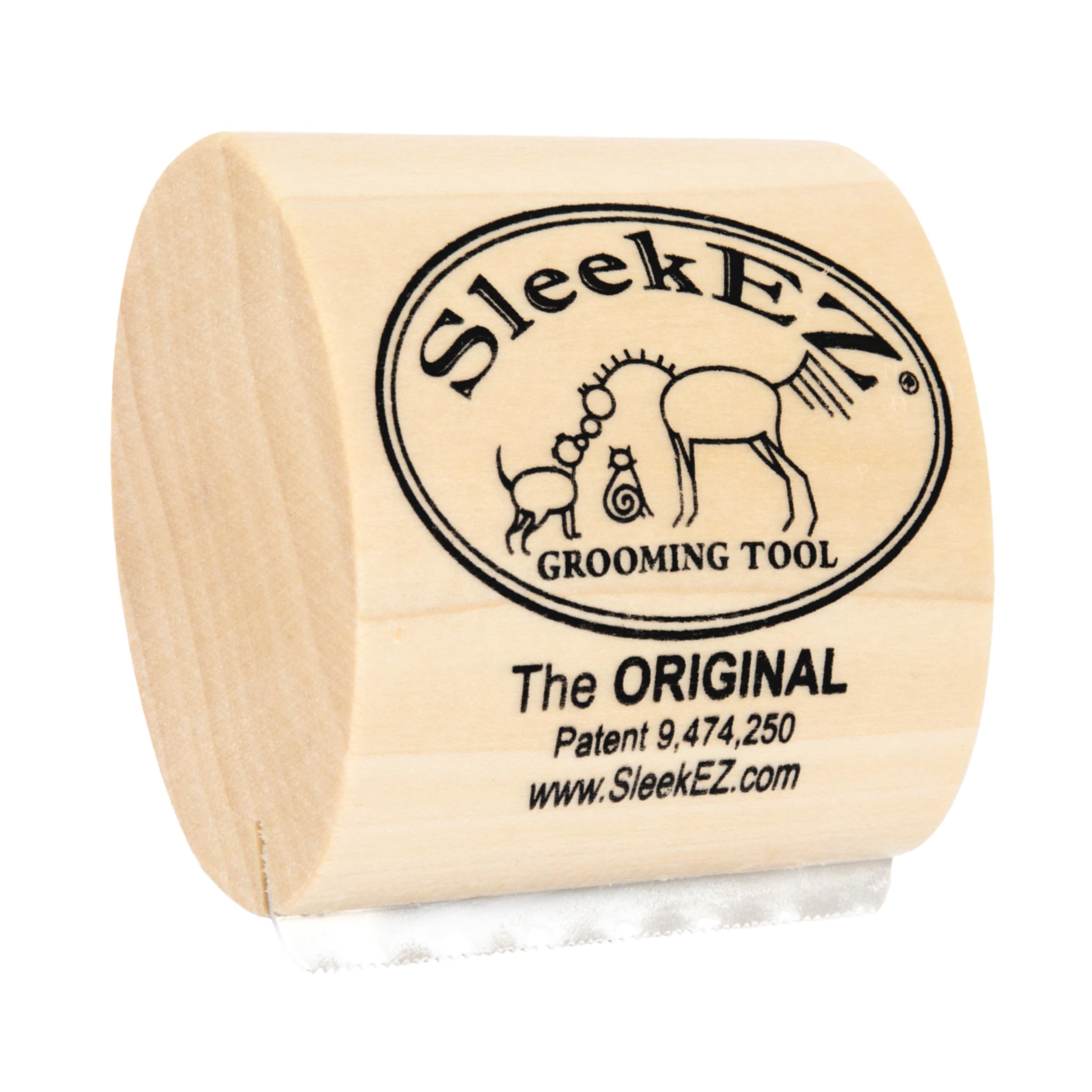
SleekEZ Deshedding Tool

SleekEZ Deshedding Tool

Undercoat deshedding

Our Score 9.0/10
Check Price

Worth Noting

  • Snags on mats instead of working through them
Weight
2 oz
Cleaning
Wipe fur off the edge
Head Size
5.5 x 3 in
Tool Type
Toothed deshedding strip
Read the full review

There are no pins here. The working end is a fine-toothed strip of metal on a 5.5-inch handle, and you use it flat against the coat in short strokes with the grain rather than against it. That motion is the whole tool: the edge gathers loose undercoat and dead hair into a roll that lifts away, and the same edge will clean a cat tree afterwards.

For a cat who flinches at pins, this is the one that gets a session in. Nothing pointy presses into the skin, so a nervous cat will often stand for it in a way they won't for a slicker, and at 2 ounces you can work one-handed while the other hand steadies a shoulder. We were struck by how quickly the roll builds along the flank — a few passes and there's a visible line of fur sitting on the edge.

The 5.5-inch handle keeps your hand close to the cat, which helps on a wriggly one, and the narrow strip works along a spine without the steering a wide brush needs. It's also the easiest of these to use on a cat perched on a windowsill, since you never need to press in.

Bottom line: For the cat who hates pins, this is our answer: a flat toothed strip that lifts loose undercoat in short strokes, provided there's no mat in the way.

7

Depets Self Cleaning Slicker

Depets Self Cleaning Slicker

Budget first brush

Our Score 9.0/10
Check Price

Worth Noting

  • Pins too soft for a dense, woolly undercoat
Handle
Rubberized non-slip
Weight
3.5 oz
Cleaning
One-click button
Pin Type
Angled pins, round beads
Read the full review

This is the least expensive slicker on the list, and it's built to that price: a plastic body, a one-click button, and stainless pins with round beads on the tips, set at an angle. It weighs 3.5 ounces and the handle is rubberized, so it sits in the hand without any fuss.

What the money buys is gentleness. The pins are the softest here, tipped with beads and angled so they comb through rather than dig, and a cat who dislikes being handled will usually sit for this one. A kitten learning what a brush is will too, which is why we're comfortable recommending it as a first tool.

Treat it as a starting point rather than a finish line: it answers the question of whether your cat will be brushed at all before you spend more, and it stays useful afterwards on a fine-coated or a nervous cat. The button pushes most of the collected fur off in a clump, and the beads leave the skin looking calm rather than pink.

Bottom line: We point new owners here to find out whether a cat will be brushed at all: soft, bead-tipped pins that suit fine coats and kittens.

8

Aumuca Cat Brush for Shedding

Aumuca Cat Brush for Shedding

Everyday long-haired brushing

Our Score 8.8/10
Check Price

Worth Noting

  • Costs as much as larger brushes here
Weight
5.6 oz
Cleaning
One-click retracting shutter
Pin Type
Angled, rubber-tipped stainless
Head Size
4.05 x 1.54 in
Read the full review

The pins decide it. They're bent at an angle and capped in rubber, so they slide under the topcoat instead of skating across the top of it — and on a long-haired cat, where a layer of guard hair sits over everything you actually want to remove, that is the difference between brushing and petting. The head measures 4.05 by 1.54 inches, which makes it a cat-sized tool rather than a dog brush used carefully, and the whole thing weighs 5.6 ounces.

Cats tend to stay for this one. If yours is the type who tolerates half a minute and then walks, this is the brush we start with: the capped tips mean there's no scratch at the end of a stroke, and the angled pins lift a surprising amount of undercoat in a short pass. Cleanup is the other half of the appeal — the one-click shutter pushes the collected fur off in a single pad, so there's no picking at the head with a fingernail between cats.

The handle took us a session or two to stop fighting; it doesn't immediately tell your fingers where to sit, though it settles once they land. A coat already felted at the skin is the real boundary — this brush lifts loose undercoat, it doesn't dissolve a mat, and pulling at one with pins only makes a cat wary of the next session.

Bottom line: Our pick for most long-haired cats: angled, rubber-tipped pins that get under the topcoat on a head sized for a cat, gentle enough that they let you finish.

How We Tested 14 Brushes on a Very Opinionated Cat

We built the shortlist from retailer best-seller pages and long forum threads where owners of double-coated cats compare notes, then filtered hard: pins under half an inch were cut for never reaching an undercoat, tips that looked molded flat rather than rounded were cut for scraping, and handles that flexed under a firm grip were cut on the spot. That left 14 brushes, which went into daily rotation for three months.

Most of the testing happened where brushing actually happens — the living room rug after dinner, the bathroom counter while the sink ran, the cat tree at 6 a.m. before work. Each session ran until the cat left, and we noted how many minutes that took. Once a week we balled up the fur each brush had collected and weighed it, which is how we separated tools that pulled loose undercoat from ones that only smoothed the surface.

Self-cleaning models got their own test: press the retract button with one thumb while the other arm holds a wriggling cat, and see whether the pad drops its fur in a single push or needs a second press after she's already gone. We rinsed and shook out every brush after each session to check how much fur stayed wedged at the base of the pins. At the end we examined pin tips for bending, coating wear, and teeth that had popped loose, then weighed that against what each brush cost.

How to Choose Brushes for Long-Haired Cats

Reach Matters More Than Anything Else

The coat you see is not the coat you're cleaning. Long guard hair lies over a denser undercoat, and a brush with short, soft pins rides along the top of it, which is why so many gentle-looking brushes look busy and collect almost nothing. Length and angle are the giveaway: pins set at an angle, like the bent needles on our top pick, slide under the surface layer and lift it.

If a brush's selling points are all about softness and it says nothing about pin length, expect to use it as a finishing tool rather than a deshedder.

Tips and Pressure, Especially Over Bony Spots

A cat's skin is thin over the spine, the hips, and the inside of the back legs, and those are exactly the places a brush gets used hardest. Rounded or capped tips are not a marketing nicety; they are the difference between a cat who stands for a second pass and one who leaves.

The other half is you. Pressing harder doesn't lift more undercoat, it just scrapes. Use short strokes with the lay of the coat and let the pins find the loose hair, and if the skin looks pink afterwards, the session was too firm.

Mats Need Teeth, Not Bristles

A mat is felted hair, and dragging a slicker through one pulls on the skin it's anchored to. Work the edge of a mat with spaced teeth — the nine-tooth side of our rake pick, for instance — pinching the mat between two fingers so you can feel what's underneath, and take it over several short sessions rather than one heroic attempt.

Mats that sit tight against the skin, or a coat that has tightened across the whole flank, are a groomer's job rather than a home project.

A Comb Finishes What the Brush Starts

Run a metal comb through the coat after brushing and the job becomes visible: anything the brush skimmed over catches on the teeth immediately. That's why a two-comb set belongs in a long-haired cat's kit even when you already own a good brush — the larger comb for the body, the smaller one for faces, legs, and the ruff.

A comb doesn't replace a deshedder. It's the check that tells you whether you need one, and it will keep working long after cheaper plastic has been thrown out.

Size, Weight, and the Button

A cat is a small animal, and a head nearly six inches across is a lot of brush to steer around one: excellent on a large cat, clumsy on a petite one. Weight shows up over a ten-minute session, and the difference between 2 and 5.6 ounces is noticeable by the end of it.

Then look at the cleaning mechanism, because the retract button is the part that wears first — one that sticks leaves you holding it down through every stroke. Rinse and dry the head before fur packs into the mechanism and it lasts considerably longer.

Frequently Asked Questions

Final Verdict

Most long-haired cats do best with one brush and one comb: the Aumuca for the daily work of lifting undercoat, and a stainless comb to check what it missed. If a mat has already formed, reach for the Maxpower rake before either of them and work the mat loose over several sessions rather than one.

And if you don't yet know whether your cat will sit for grooming at all, start with the Depets. It's the cheapest way to find out whether brushing becomes a habit or a negotiation.