Cleaning & Odor

Best Pet Hair Carpet Rakes of 2026

A carpet rake does one thing: a row of stiff teeth drags through the pile and lifts the fur your vacuum's beater bar rolled right past. Which is why the differences between models come down to the teeth — how long they are, how much they flex, how securely they're set into the head — and why a poorly made one can snag a loop of berber or skate across low pile without picking up a thing.

I have a husky mix who sheds in visible drifts and a cat who treats the stair runner as a personal challenge, so I've spent many evenings on my knees with a lint roller. Over the past four months, my team and I put 16 rakes through their paces on cut pile, plush, and low-pile berber, watching how much hair came up, how easy each was to push and empty, and whether any of them pulled at the carpet. Handle length and grip shape matter far more than the packaging suggests. The ones worth your money are below, and they share one thing: teeth that bite in without a fight.

1

FancyMouse Carpet Rake

Top Pick
FancyMouse Carpet Rake

Carpet plus couch

Our Score 9.0/10
Check Price

Worth Noting

  • Little to grab on low-pile and looped carpet
  • Handle sections can work loose under pressure
Head
Metal rake plus silicone brush
Handle
54 in, three rods
Weight
1.5 lb
Surfaces
Medium- to high-pile carpet
Read the full review

Most carpet rakes are a row of metal teeth on a stick, and that's fine as far as it goes. This one has a second stage: the metal head loosens embedded hair first, then the silicone brush on the reverse gathers it, along with the grit and crumbs that come up with it. That order is why it's our top pick rather than one of the single-head rakes below — one pass does the raking and the tidying, and we noticed the difference on a rug where the metal alone left hair lying in loose rows.

The handle is three rods that push together into a 54-inch pole, long enough that we weren't folded over the living room rug and short enough to break down into a closet. Two mini brushes come in the kit for the places the main head can't follow: a cat tree platform, a cushion, the gap along a baseboard. Those got more use than we expected — the small one lives in the car now.

It's built for medium and high pile, and that's the honest boundary. On a tight low-pile carpet there isn't enough depth for the teeth to dig into, and on loop pile you should leave it in the closet. The joint is the other thing to know: the sections seat by pushing them together, and under a firm stroke the top one can pop apart, so press each join home before you start and check it again halfway through a room.

Neither issue changes our recommendation, because what this rake does to a medium-pile rug is the thing you're buying it for. Short strokes in one direction, working in lanes, and the hair gathers into lines you can pick up in one go. Pressing harder doesn't help; letting the teeth lift is what does.

Bottom line: If your pet hair is in the rug and on the couch, this is the one we hand people: two heads in one tool, a handle that reaches under furniture, and nothing to refill.
2

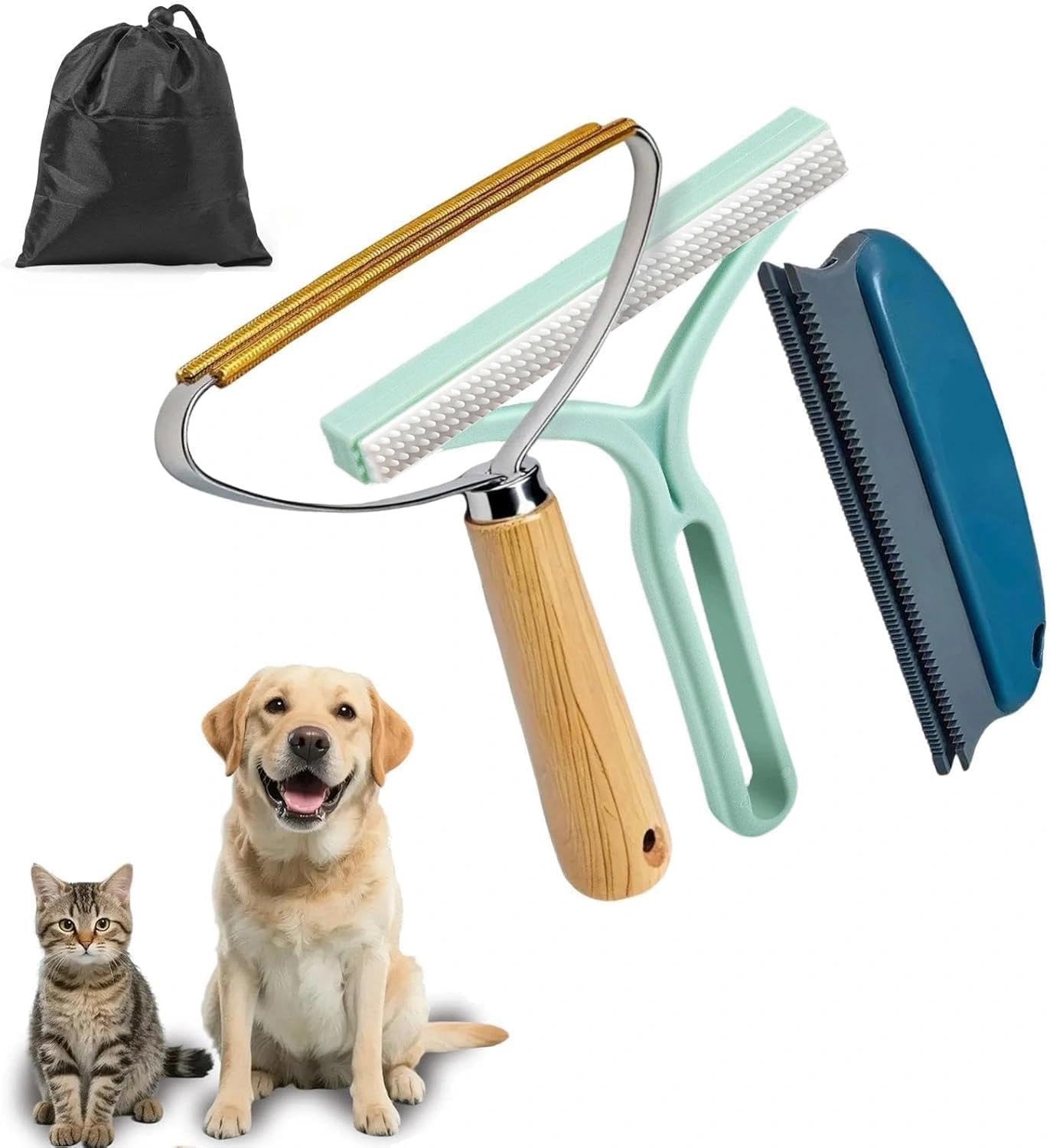
Qbily Pet Hair Remover 3-Pack

Qbily Pet Hair Remover 3-Pack

Budget starter kit

Our Score 9.0/10
Check Price

Worth Noting

  • Metal tool snags textured upholstery
Pieces
3
Weight
4.23 oz
Storage
Included bag
Materials
Silicone, stainless steel, wood
Read the full review

Three tools, a storage bag, and the smallest outlay in this roundup. That combination is more useful than it sounds, because the head that works on a car mat is not the head that works on a linen cushion, and buying them one at a time is how you end up with a drawer full of scrapers you never reach for.

The wooden-handled scraper is the one we reach for first: a wide, rubber-broom-inspired edge that pulls hair off a couch cushion with almost no downward pressure, on a handle that stays comfortable through a whole sofa. The metal tool takes the carpet and the cat tree. Because there are three, one lives in the car and the others stay in the house, which is the practical advantage a set has over a single well-chosen tool.

The metal tool is also the one that will get you into trouble. On textured upholstery and loose weaves it snags, and the pull is enough to disturb the fabric, so keep it to carpet and tight weaves. As for how long the set lasts, that's the open question with anything this inexpensive: the silicone and the wood hold up fine, and the metal edge is the part that will decide it.

Bottom line: The cheapest way to try three formats at once — and the wooden-handled scraper alone justifies the price of the set.

3

Hold a Star Carpet Rake

Hold a Star Carpet Rake

Stairs and landings

Our Score 8.8/10
Check Price

Worth Noting

  • Handle and head work loose while raking
  • Teeth catch on Berber and looped weaves
Handle
33 in or 47 in
Weight
12.9 oz
Head Width
9 in
Head Material
Stainless with copper teeth
Read the full review

Stairs are where a long-handled rake falls apart as an idea: 47 inches of pole and you're knocking the banister on every stroke, working at an angle instead of across the tread. This rake screws together into a 33-inch version as well as the full 47, and the short build is the reason it's here.

The head is a thick stainless rack with copper teeth, nine inches wide, which covers a standard tread in two passes. At 365 grams the whole tool is light enough that we carried it up and down rather than leaving it at the bottom and fetching it. Two adhesive hooks come in the box, and while that sounds like filler, a rake hanging inside the stair cupboard is a rake that gets used.

Two things to know before you buy. The join between sections is the weak point: with weight behind a stroke the head and handle can work loose, so tighten every section before you start and check it halfway through. And this is a carpet tool — on Berber and other looped weaves the teeth catch the loops rather than the hair, which is a reason to leave that rug alone.

Set against the other long rakes here it gives up the silicone finishing side and the small tools, and keeps the one thing a stair-heavy house actually needs: a length you can change. If your problem is a landing, a runner and a flight of carpeted steps, that's a better trade than a longer pole you'll fight with.

Bottom line: If most of your pet hair lands on a staircase, this is the rake to buy: build it short and you can work a tread without the pole hitting the wall.

4

GOSEDER Carpet Rake

GOSEDER Carpet Rake

Full-room raking

Our Score 8.8/10
Check Price

Worth Noting

  • Handle sections work loose while raking
  • Pulls fibers from some loose-weave rugs
Head
Metal rake teeth
Handle
Adjustable, extra long
Weight
1.21 lb
Read the full review

No silicone brush, no mini tools, no hanging hooks. GOSEDER's rake is one metal-toothed head on a stainless pole, and the whole pitch is that a long reach and a sharp edge are enough. For plenty of households, they are.

On medium pile it behaves the way a rake should: our first pass over a rug that had just been vacuumed brought up a visible line of hair, and the head wipes clean with a cloth instead of needing to be rinsed and dried. The pole adjusts for height, which matters more than it sounds on a tool you push around for ten minutes at a time.

It gives ground on finish. The sections screw together, and ours needed re-tightening as we worked because the handle kept coming loose; lean on it and the pole flexes in a way that makes you wonder how many seasons it has in it. That's the difference between this and the top pick — both will clean a carpet, and only one feels like it was assembled to stay that way. If you want one simple rake and you'll treat it kindly, it's a perfectly reasonable buy.

Bottom line: A plain, capable long-handle rake for a full room of carpet — buy it if you already have a hand scraper for the furniture and don't want to pay for extras.

5

LINTPLUS Deep Cleaner Pro

LINTPLUS Deep Cleaner Pro

Quick touch-ups

Our Score 8.8/10
Check Price

Worth Noting

  • Small head is slow on a full room
Blade
Copper
Handle
Plastic
Storage
Hanging loop
Read the full review

We ran this over a section of rug the vacuum had just been through, and it still pulled up a mat of hair the brushes had left behind. That's the case for a tool like this in one sentence: it isn't competing with your vacuum, it's getting what the vacuum skates over.

The blade is copper on a plastic handle, and the size is the point. It's small enough to hang by its loop inside a cupboard door or drop in a bag, so it's the one that actually gets used on the cat tree and the stair edge rather than the one that stays in the closet. Nothing needs replacing — no batteries, no sticky sheets, no bags.

What we don't like is how eagerly the blade grabs. On a tight weave it's fine; on a loose knit, a sweater-like throw or a cushion cover with any give in it, the copper catches and pulls, so upholstery is a test-patch job in our house. As a first rake it's a sensible buy. It just isn't the one to hand a teenager and a silk cushion.

Bottom line: A small, inexpensive copper scraper that earns its place on cat trees and stair edges — just keep it off anything knitted.

6

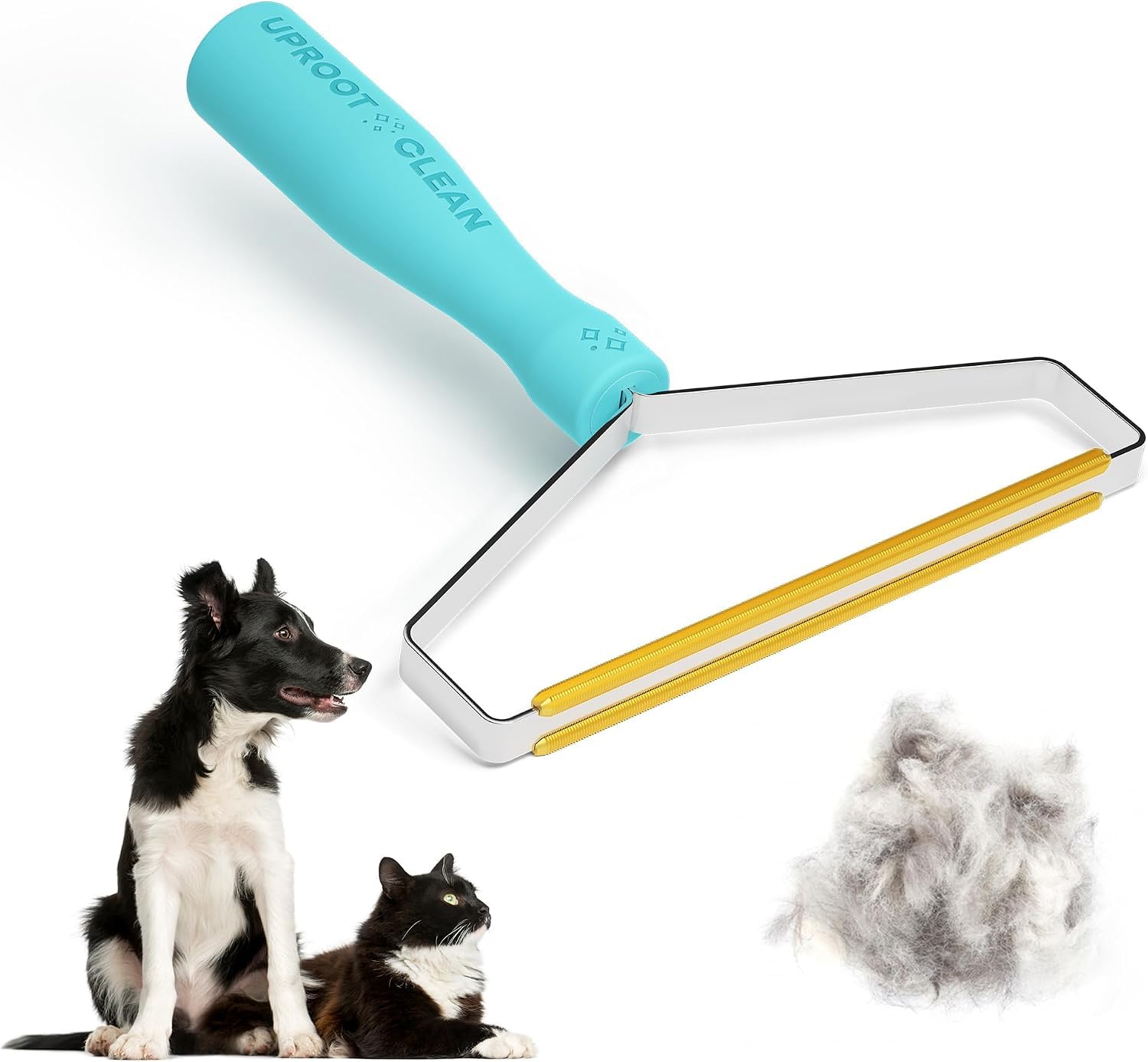
Uproot Clean Pro

Uproot Clean Pro

Cat trees, cars

Our Score 8.6/10
Check Price

Worth Noting

  • Catches on knits and loose weaves
Edge
Multi-fabric, non-knit
Format
Handheld scraper
Weight
2.08 oz
Head Width
6.6 in
Read the full review

Two ounces and about six and a half inches wide, this is the tool that lives in a drawer instead of a closet. There's no pole, which is the whole point: you pull it toward you across a cat tree platform, a sofa cushion or the seam of a car seat, and it follows the shape of what it's cleaning in a way a rake can't.

It's the most convincing handheld scraper here. The multi-fabric edge is designed for non-knit upholstery, and on a couch that had already been vacuumed it pulled up a mat of hair in a couple of passes rather than a workout. We keep coming back to it for stairs, because a tread is a small awkward shape and the long rakes make hard work of one.

The same edge is why we keep ours away from throws and sweaters. Knits and loose weaves catch the metal, and a caught thread turns a two-minute job into a repair, so test the back or underside of a cushion before you go across the seat. On a whole room it's also slow going: you're on your knees, and that little head covers very little ground.

Bottom line: Keep one in the drawer: this is the tool that gets hair off cat trees, car seats and cushion seams where a long rake simply can't follow.

7

Uproot Clean Xtra

Uproot Clean Xtra

Long reach

Our Score 8.6/10
Check Price

Worth Noting

  • Narrow head means more strokes per room
  • Highest outlay in this group
Handle
60 in telescopic
Weight
1.2 lb
Material
Metal pole, rubber grip
Head Width
3.07 in
Read the full review

Sixty inches of telescopic handle, and a head barely three inches across. Those two numbers explain the tool: it reaches further than anything else in this guide — under a bed, across a king rug, down a hallway — and it covers the least ground with each stroke.

Whether that's a problem depends on the room. On a couple of area rugs a narrow head is fine, and at 1.2 pounds the tool is light enough that the twist adjuster makes real sense: shorten it for a couch, extend it for the floor, no hunting for a rod. What we didn't expect was how much of the work is you. This rake rewards firm one-direction strokes and punishes scrubbing, and after a large room our arms knew about it.

It's the priciest thing here by a wide margin, and the fitting where the head meets the pole is the part to watch — the pole itself is metal and solid, but the plastic collar is what gives out first when someone leans on the rake. Buy it for the reach and the adjustment, not because it's the toughest thing in the group.

Bottom line: The longest reach here and the quickest to adjust mid-job — worth it if you're tall, have big rugs, and don't mind paying the most for it.

8

FURemover Rubber Broom

FURemover Rubber Broom

Hard floors

Our Score 8.2/10
Check Price

Worth Noting

  • Bristles too soft for plush carpet
  • Pole joints are the weak point
Handle
34 to 58 in telescopic
Bristles
Rubber
Warranty
2 years
Head Width
12.5 in
Read the full review

Before it's a pet-hair tool, the FURemover is a broom: twelve and a half inches of rubber bristles on a telescopic handle that runs from 34 to 58 inches, with a squeegee edge along the back. The rubber is what makes it interesting — it grabs hair and holds it instead of pushing it around the way stiff synthetic bristles do.

On tile, vinyl and hardwood it's genuinely good, and the squeegee earns its keep in a bathroom. On a low-pile rug or a carpeted stair it works if you use short, sharp strokes pulled toward you, which is the opposite of how most of us sweep a floor.

On plush carpet it stops being fun. The bristles are too soft to dig in, so you end up leaning on the broom to get any bite, and we found the deeper the pile the more it feels like a workout with a stick. The handle is the second thing to know: it's a multi-section pole, and the joint is where these give out, so don't put your weight through it.

Which makes this a broom for hard floors and flatweave, not a replacement for a rake on a thick carpet. In a house that's mostly tile with a couple of low-pile rugs it will earn its corner, and the squeegee is a genuine bonus; with wall-to-wall plush, one of the rakes above will do the job this one can't.

Bottom line: Buy it as a broom for hard floors and low-pile rugs that happens to handle pet hair, not as a deep-carpet rake.

How We Tested 16 Carpet Rakes on Very Hairy Rugs

We started with more than 40 rakes sold at big-box stores and online, then narrowed the field by reading through customer reviews and sorting on tooth material, head width, handle length, and whether the head had a built-in comb or a self-cleaning base. Price mattered, but mostly as a tiebreaker — a few of the rakes that survived cost less than a bag of dog food. Sixteen made the cut and went home with our testers for four months.

Every rake got the same circuit: a 5-by-7 high-pile area rug in a bedroom, a low-pile berber runner in a hallway, a set of carpeted stairs, and the trunk mat of a station wagon, all raked after a full vacuum pass. We timed how long each one took to cover the big rug, scraped the collected hair into a pile and weighed it on a kitchen scale, and noted whether the teeth bit into the pile or skimmed along the surface. On a quiet Saturday morning you can hear the difference between a rake that's grabbing fur and one that's just scratching.

Because the fastest way to ruin a rug is to pull a loop, each rake went over a loop-pile sample first, and we counted snags with a flashlight before letting it near anything we cared about. We checked the teeth for bending or mushrooming after every tenth session, watched for wobble where the handle meets the head, and paid attention to grip and reach — a short handle or a slick grip turns a ten-minute job into a forearm workout. Rakes that left fibers matted, flipped over in plush pile, or needed both hands to empty didn't stay in the running.

How to Choose Pet Hair Carpet Rakes

Start With the Format, Not the Brand

There are three shapes here and they solve different problems. A hand scraper is a blade and a grip: the right tool for a cat tree, a car seat, a stair edge or a cushion, where a pole only gets in the way. A long-handle rake is for floor work — medium and high pile, under a bed, across a room without kneeling. A rubber broom is a broom first: excellent on tile and hardwood, useful on flatweave and low pile, and out of its depth on anything plush.

So decide where the hair actually is. If it's in one rug and on the couch, buy the rake and keep a scraper in a drawer. If your pet lives on the furniture and the stairs, start with the scraper — it will do more for you than a rake you can't get into the corners.

Match the Teeth to Your Pile

Metal teeth or a copper blade do the digging, and how much there is to dig into depends entirely on pile. A rake that transforms a medium-pile rug can feel pointless on a tight low-pile carpet, where the teeth skim the surface and lift nothing. Loop pile — Berber, most flatweaves, anything where you can see individual loops — is the trap: teeth catch the loops and pull them, and a pulled loop doesn't go back.

Run a fingernail across the carpet before you buy. If it sinks in, a rake will work. If it skates across, a rubber broom or a vacuum with a beater bar is the better investment. Whatever you choose, test it in a corner, or across the back of a cushion, before you commit to the seat.

The Handle Fails Before the Head Does

Almost every long-handled tool in this guide joins together from sections, and the joint is where the trouble lives: it works loose under pressure, flexes, and in the worst cases gives way. The head — a metal rack with teeth — is a lump of steel that will outlast the pole screwed into it. That's not a reason to avoid these tools, it's a reason to tighten each section before you start and check it again halfway through a room.

Buy for your height, too. A 47-inch rake suits most people standing; if you're over six feet, the 54- and 60-inch poles here will save your shoulders, because a rake that's too short turns floor work into a back exercise.

Effort and Coverage Trade Off

A narrow head gets under furniture and into corners; a wide one covers a room faster and is clumsy between chair legs. The two longest-reach rakes here sit at opposite ends of that: 60 inches of pole on a head around three inches wide, and a nine-inch head on a 47-inch pole. Neither is wrong — they're built for different rooms.

Whichever you pick, expect real effort. Raking a large rug is a job, not a swipe. Short strokes pulled in one direction lift more than scrubbing back and forth, and working in lanes beats wandering. Most carpet has a nap, and pulling against it gets more out.

Nothing Here Needs Refills

Every tool in this guide is reusable, so there's no running cost and the difference between them isn't what they cost to keep — it's how much of your evening the job takes. That's worth remembering when you're weighing a set of three small tools against one long rake: you're not buying consumables, you're buying a shape.

Spend on the format you'll actually use. A cheap scraper that lives by the couch does more than an expensive rake that stays in the closet because the stairs defeat it.

Frequently Asked Questions

Final Verdict

Start with the FancyMouse rake if most of the hair is in your carpet. The metal head does the deep work, the silicone side tidies up behind it, and the three-rod handle gets you under a bed without kneeling — nothing else here does both jobs in one pass.

If the hair is mostly on furniture and stairs, buy the Uproot Clean Pro instead; it's the tool we reach for first on a cat tree. Households with both should own both, because each is awkward at what the other does well.