Carriers & Travel

Best Hard-Sided Cat Carriers of 2026

Every hard-sided cat carrier looks fine in the living room. The failure happens in the parking lot, when the latch gives a quarter inch and twelve pounds of determined cat decides to make a run for it. I've chased a cat across a vet lot before, and once was enough. What you're actually buying here is a box that stays shut, holds its shape when you carry it one-handed with keys in the other hand, and opens in a way that gets a scared animal inside without a wrestling match.

We spent six months with 14 carriers, from kitten-sized models to roomy boxes for a 15-pound cat, and assembly alone sorted them fast — some snapped together in under a minute, others had me chasing screws across the counter. Size trips up more buyers than anything else, so measure your cat from nose to tail base and add a couple of inches; a carrier your cat can stand up in is a different purchase than one he merely fits inside. Value, in the end, is the carrier that still latches cleanly two years in, and the picks below are grouped by what each one does best.

1

Petmate Two-Door Kennel 24"

Top Pick
Petmate Two-Door Kennel 24"

Most cat households

Our Score 9.2/10
Check Price

Worth Noting

  • 15-pound limit excludes larger cats
  • 5.2 pounds empty and bulky to store
Entry
Top and front doors
Dimensions
24.1"L x 16.8"W x 14.5"H
Weight Limit
15 lb
Carrier Weight
5.2 lb
Read the full review

The top door is what makes this carrier worth recommending first. A cat that plants its feet at the front opening can be lowered in from above, and the front door gives you a second route when it is calm enough to walk in. We used that overhead opening most on vet mornings, when a cat is already tense and a quick, controlled load matters more than anything else. The 24.1-by-16.8-by-14.5-inch shell gives most cats up to 15 pounds room to stand and turn, and the molded plastic feels rigid rather than flexy.

We also appreciate the hardware. The top and bottom sections are held with screws as well as latches, and the spring-loaded door latches open one-handed. That matters when one hand is on the cat and the other is on the door. The wire door and side vents keep air moving; the top opening adds ventilation too. At 5.2 pounds empty, it is a two-hand carry once a cat is inside, but the built-in handle is comfortable enough for the walk from the car to the clinic.

The two-door design solves the part of carrier use that goes wrong most often: getting the cat in without a chase. It meets most airline cargo specs, though that is not the same as fitting under a seat, so check your airline's rules before flying. For a cat that has learned to go limp at the sight of a front door, the overhead opening is the whole purchase.

Bottom line: For most cats up to 15 pounds, this is the hard-sided carrier we recommend first: the top door makes loading easier, the 24-inch shell gives real room, and the latches feel secure.

2

Amazon Basics 2-Door Top-Load

Amazon Basics 2-Door Top-Load

Large cats

Our Score 9.2/10
Check Price

Worth Noting

  • 13-inch interior is tight for tall cats
Entry
Front and top doors
Dimensions
22.83"L x 14.96"W x 12.99"H
Weight Limit
20 lb
Carrier Weight
4.54 lb
Read the full review

The 20-pound weight limit is the number that earns this carrier a place. It is the two-door pick for a cat that has outgrown our top choice, and the 22.8-by-15-by-13-inch shell has a wide floor even though it is shorter in height. We loaded a big cat through the top opening and found the steel-wire door gives a clear view in and out; the plastic shell stays rigid when you lift it with a cat inside.

The top door is the feature we used most, but it is also where the carrier asks for attention. The latches can be stiff, and the top panel depends on the screws and side clips being fully seated. Check both before you lift the carrier, and do not rely on the clips alone. In return, you get a second entry that makes a nervous cat easier to lower in, plus more ventilation than a solid-door kennel.

Against the Petmate, this one gives up some interior height but adds five more pounds of capacity and a lower price. That is the right trade for a 17- or 18-pound cat, or for a household that wants a second carrier for the car. The top door is still the reason it stays in the lineup.

Bottom line: If your cat is closer to 20 pounds, this is the two-door hard carrier we point to: more weight capacity than our top pick, steel-wire doors, and a top opening for easier loading.

3

Petmate Top Load 19"

Petmate Top Load 19"

Small cats

Our Score 9.2/10
Check Price

Worth Noting

  • 10-pound limit and low 10.8-inch height
  • No front door for cats that prefer to walk in
Entry
Top door only
Dimensions
19"L x 12.5"W x 10.8"H
Weight Limit
10 lb
Carrier Weight
2.4 lb
Read the full review

At 2.4 pounds empty, this is the carrier we grab when the trip is short and the cat is small. The 19-by-12.5-by-10.8-inch shell is compact, and the top-load door makes it easy to lower a kitten or a lightweight cat in. The size means you can carry it against your hip instead of holding it away from your body.

The molded shell wipes clean, and the stay-dry moat around the floor is a useful detail after a car-sick episode. Ventilation comes from holes in the plastic rather than a wire door, so it is less airy and less visually open than the steel-door carriers. The snap closure is simple, and the top-load door is easy to work one-handed. It meets most airline cargo specs, but at this size that is a cargo claim, not an under-seat guarantee.

For a kitten or a petite adult, the light weight is the whole point: it is the one that disappears into a closet and does not punish your arm on the walk into the clinic. A cat that likes to stretch out will be happier in a 24-inch carrier, but a small cat does not need that much shell.

Bottom line: For a kitten or a cat under 10 pounds, this is the lightest, simplest hard carrier here: a 2.4-pound top-load shell that is easy to carry and easy to lower a cat into.

4

SportPet Large Side-Opening

SportPet Large Side-Opening

Easy loading

Our Score 9.2/10
Check Price

Worth Noting

  • Less rigid than a molded kennel
  • No top door if a cat refuses to walk in
Entry
Wide side door
Storage
Folds flat
Dimensions
18.5"L x 15.25"W x 14.25"H
Weight Limit
25 lb
Read the full review

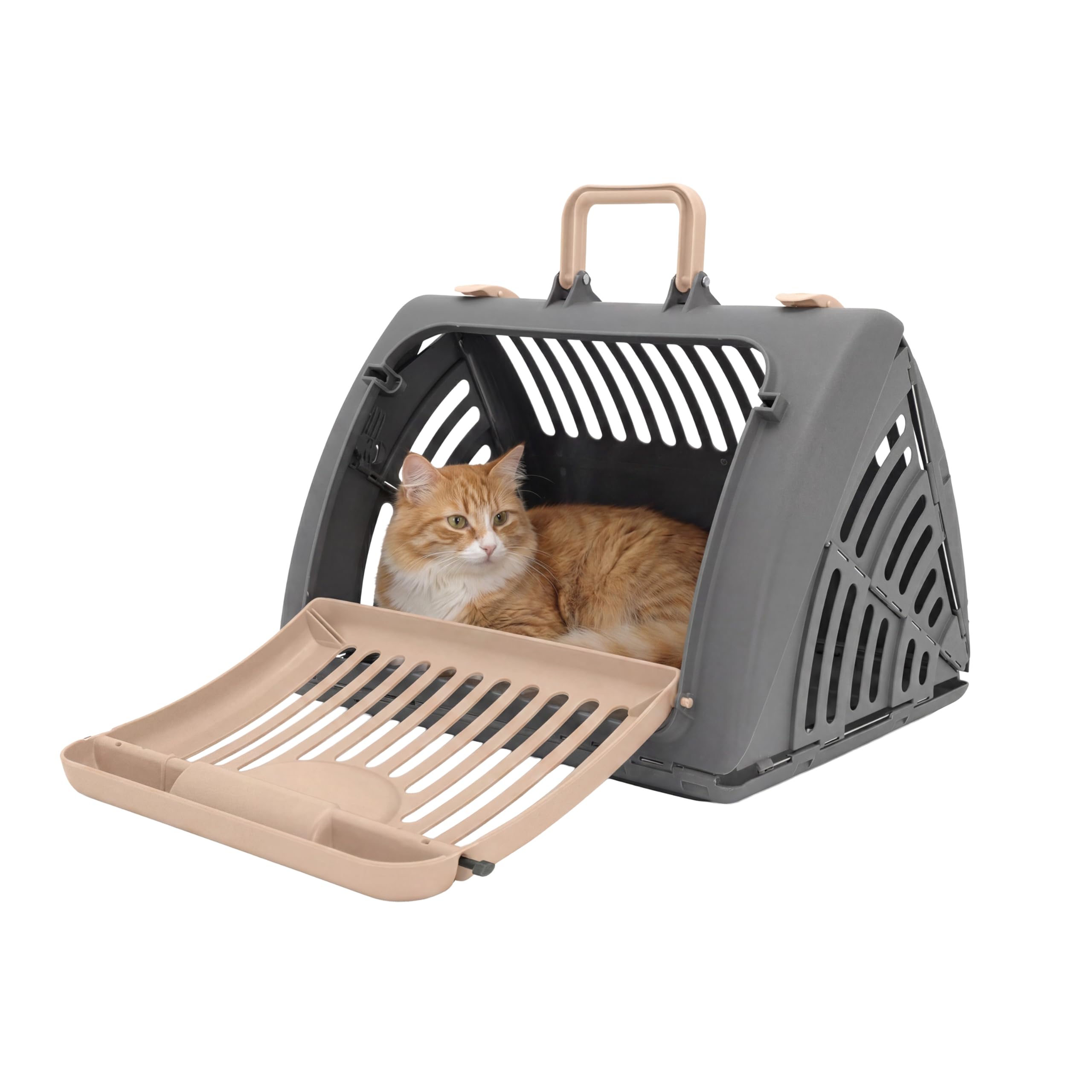
The wide side door is the reason to choose this one. Instead of lowering a cat through a top hatch or pushing it through a front opening, you open the whole side and let the cat walk in. We found that useful for a cat that backs away from an overhead opening; the included bed also gives the carrier a familiar smell and a softer floor from the first trip.

When the trip is over, the carrier folds flat to a briefcase-like shape, which is the difference between storing it in a closet and leaving it assembled in the garage. The 18.5-by-15.25-by-14.25-inch shell is rated for pets up to 25 pounds, and the plastic feels sturdy in normal handling. The fold-flat mechanism is the trade-off: it adds hinges and clips that a one-piece shell does not have.

Check that the sides lock open and the door closes flush before each trip, especially if the carrier has been stored flat for months. That is a maintenance step, not a reason to avoid it. At 4.3 pounds, it is lighter than the 24-inch Petmate but heavier than the 19-inch top-load. The wide opening also makes cleanup easier after an accident, which is more than we can say for some narrow-door carriers.

Bottom line: For a cat that hates being lowered through a top door, this is the pick: a wide side door lets the cat walk in, and the shell folds flat when the trip is over.

5

Amazon Basics Single-Door Kennel

Amazon Basics Single-Door Kennel

Simple front entry

Our Score 9.2/10
Check Price

Worth Noting

  • No top door for resistant cats
  • Bulky 23.6-inch shell
Entry
Front door only
Dimensions
23.6"L x 15.7"W x 13"H
Weight Limit
25 lb
Door Material
Metal wire
Read the full review

There is no top hatch here, and that is the first thing to know. The front-only door makes this a carrier for a cat that will walk in or can be backed in without a fight; a cat that braces at the sight of an opening will be easier in one of the two-door picks. What you get in return is the largest weight rating in this group, 25 pounds, and a 23.6-by-15.7-by-13-inch shell with metal wire on the door and sides.

We liked the wire panels for ventilation and visibility. A nervous cat has more to look at than a solid plastic wall, and air moves through the sides on a warm day. The latch and snap closure are simple to operate, and the plastic wipes clean. The shell is bulky, though, and the front door is the only entry, so loading takes more planning than with a top-load carrier.

This is the sensible choice for a calm 20-pound cat or a household that wants a simple crate for the car and the vet. The wire door gives a nervous cat more to look at than a solid hatch, and the shell is easy to wipe between trips. We keep it in the lineup because capacity and simplicity matter, and not every cat needs a second door.

Bottom line: If you need the largest hard-sided carrier here and your cat will walk through a front door, this simple kennel gives you the most weight capacity for the lowest price.

How We Chose and Tested the Best Hard-Sided Cat Carriers

We began with a shortlist of roughly 40 carriers sold by pet specialty shops and the big-box stores, then cut anything with a molded shell and no second door, anything whose listed weight capacity wasn't at least double the carrier's own weight, and anything that showed up in owner reviews with the same complaint about a latch popping open. That left 14, deliberately spread across the price and size range a real shopper faces, from compact models to boxes big enough for a large male cat.

Each carrier came out of the box onto my kitchen counter without instructions. I timed the build, noted whether the panels seated with a click or needed force, and ran a finger along every seam looking for gaps a paw could work into. Then the harder test: I loaded each one with a 15-pound sandbag, lifted it by the handle alone, and carried it a full lap around the block — long enough to feel whether the top panel sagged, the handle flexed, or the whole box torqued. I pushed and shook each latch the way a cat shoves at a door, and dropped every carrier from counter height with the weight still inside to see whether it landed shut.

The part that mattered most happened on actual vet runs and car rides over those six months, with two cats of very different temperaments: one who walks in for a treat and one who needs the top opening. We timed how long each loading took, whether the door latched one-handed while the other hand held a squirming animal, and whether the cat could stand, turn, and lie down without his nose pressed to the door. After a car-sick episode we wiped the interior with a damp cloth and checked whether the seams held onto the smell. Two carriers that looked spendy on the shelf have been the cheapest per year of use so far; two cheap ones cracked at the hinge within weeks.

How to Choose Hard-Sided Cat Carriers

Size the interior around your cat, not the weight limit

Weight ratings are a rough guide, not a fit guarantee. A tall 12-pound cat can be cramped in a 13-inch-high carrier, while a long 15-pounder may need the 24-inch shell. Measure from the floor to the top of the cat's head and from the base of the tail to the nose, then add about two inches. The carrier should let the cat stand, turn around, and lie down. If the number is close, size up rather than trusting the pound rating.

Pick the entry around your cat's loading style

Entry design changes the entire experience. A top door lets you lower a resistant cat in from above; a front door suits a cat that walks in on its own; a wide side door is the easiest walk-in option. We put top-load access first for most cats because it gives you a controlled way in when the cat is already stressed. Check that the door latches with one hand and that the opening is wide enough for your cat's shoulders. A second door is worth paying for if loading is a struggle.

Check the closure before you trust the shell

A rigid shell is only as secure as its door and the joint between top and bottom. Look for screws or bolts in addition to side clips, and a door latch that seats firmly rather than relying on friction. Before the first trip, assemble the carrier, close it, and push the door and top panel from the inside. If the top lifts or the door flexes, add the screws or choose a different carrier. This is also where a cheaper carrier can disappoint: the shell feels strong, but the door hardware is the weak point.

Match the carrier to the car, the plane, and your storage

For car travel, a hard-sided carrier should sit flat on the seat or floor and be secured with a seat belt or tether so it cannot slide. For flights, airline approved usually refers to cargo specs, not in-cabin fit; check your airline's exact rules and measure the carrier before you buy. Storage matters too. A 24-inch molded kennel takes shelf space, while a fold-flat carrier such as the SportPet collapses to a briefcase shape. If you have a small cat and a long walk, carrier weight matters as much as interior size.

Frequently Asked Questions

Final Verdict

The Petmate Two-Door Kennel 24" is the carrier we recommend first for most cats. Its top door turns a difficult load into a controlled one, the 24-inch shell gives a 15-pound cat room to stand and turn, and the screws and latches make the shell feel secure. If your cat is over 15 pounds, choose the Amazon Basics 2-Door Top-Load instead; it gives up some height but adds capacity. For a cat that refuses a top door, the SportPet's wide side opening is the better route.