Health & Wellness

Best Hairball Remedies for Cats of 2026

It usually starts around 3 a.m. with a sound somewhere between a cough and a garbage disposal, and by the time you find the cat, the evidence is already on the rug. Cats spend a huge chunk of their day grooming, and the hair that comes off the brush and off their tongue doesn't always keep moving through the digestive tract the way it should. A good hairball remedy helps that hair pass quietly out the other end instead of coming back up on your carpet, which is a better deal for both of you.

The catch is that a remedy only works if your cat actually swallows it. My team and I spent the past three months putting 14 pastes, gels, chews, powders, and food toppers through real-life testing with a panel of nine cats, and the pattern held every time: the formulas that reduced hairballs were the ones the cats were willing to eat. Here's the thing nobody tells a first-time buyer — a plain petroleum-based paste isn't automatically more effective than a flavored gel, and a powder your cat neatly eats around is worth nothing at all. The picks below cleared both hurdles, the cats and the carpet.

1

Pet Honesty Hairball Chews

Top Pick
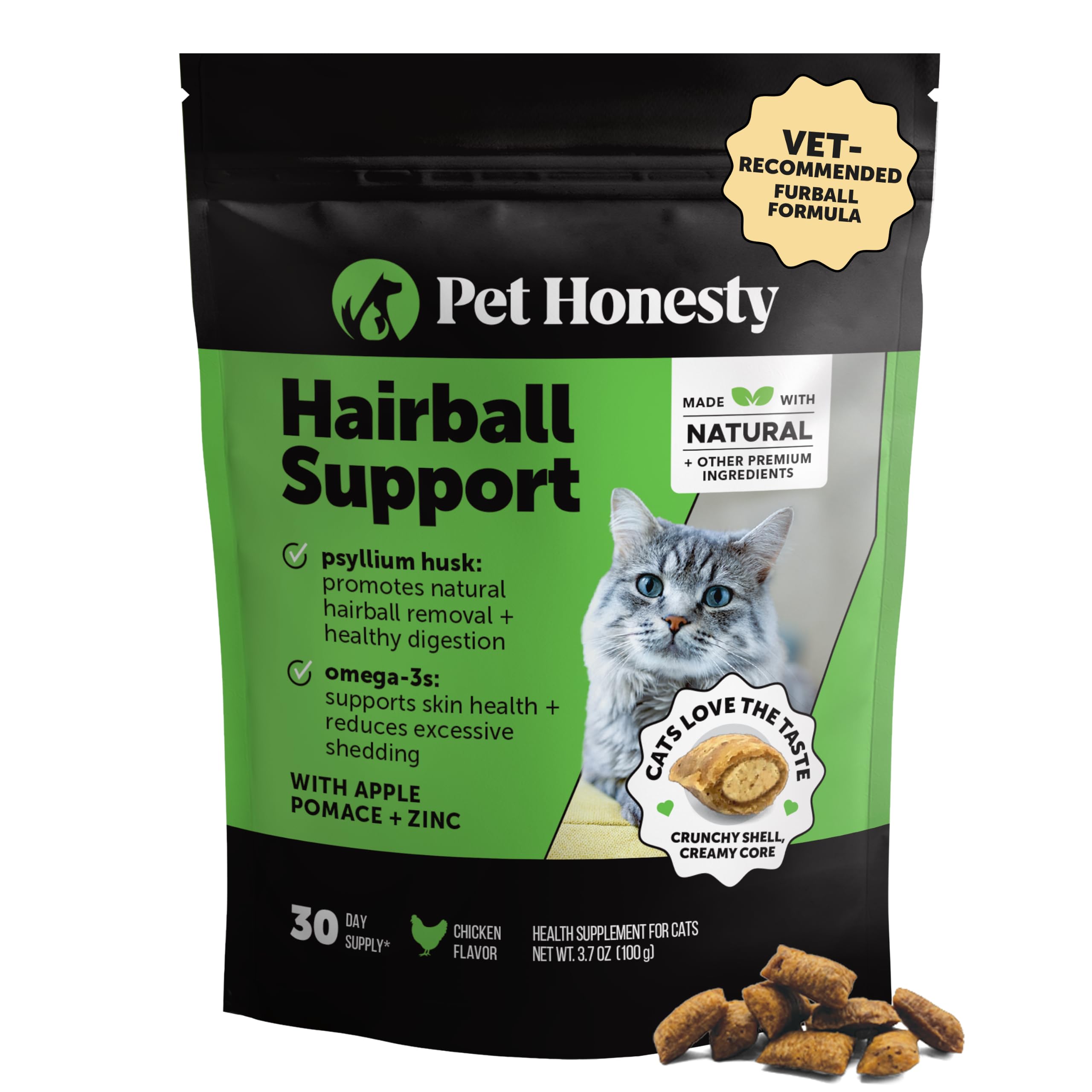
Pet Honesty Hairball Chews

Daily prevention

Our Score 9.2/10
Check Price

Worth Noting

  • Some cats refuse chews outright
Form
Dual-texture chew
Flavor
Chicken
Package Size
3.7 oz bag
Active Ingredients
Citrus pulp, apple pomace, psyllium husk, zinc methionine, omega-3s (fish oil, lecithin)
Read the full review

Most hairball remedies fail at the same place: the cat's mouth. These Pet Honesty bites get past it because they do not read as medicine — a crunchy shell around a soft center, chicken flavored, handed over like any other treat. Behind that is a real fiber blend of psyllium husk, apple pomace, and citrus pulp, with fish oil for the coat, which is why this is the pick we put first.

Fiber is the patient approach. Psyllium and fruit fiber add bulk in the gut so swallowed hair moves out rather than back up, and it works best given daily, before the hairballs start. That is where the chew format earns its keep: no tube, no gel smeared on a paw, no negotiating with a cat that has learned what the tube means.

The bag is built around a month of daily doses, and that is the honest way to read the cost — a little more per day than a tube of gel, in exchange for a dose the cat comes running for. In a multi-cat house the math gets steep fast, since one bag will not carry three cats through a month.

It is worth being plain about what this is not: prevention, not rescue. A cat already retching daily or off its food needs a vet, not a bigger scoop of fiber. For the slow accumulation of fur through shedding season, which is the ordinary case, this is the bag we keep on the shelf.

Bottom line: Our pick for most homes: a chicken chew cats eat like a treat, with psyllium and fruit fiber doing the hairball work every day.

2

PetAg Hairball Solution Gel

PetAg Hairball Solution Gel

Two-cat homes

Our Score 9.0/10
Check Price

Worth Noting

  • Petroleum-based gel, which some shoppers avoid
Base
Petrolatum, glycerin, vegetable oil
Form
Lubricant gel
Size
Two 3.5 oz tubes
Age Range
Cats 6 months and older
Read the full review

Two 3.5-ounce tubes in one box is unusual here, where most remedies come as a single small tube, and it is the reason this gel earns a place: one order covers a two-cat household through a whole shedding season. The formula is petrolatum, glycerin, and vegetable oil, labeled for cats six months and older.

The mechanism matches the other gels — coat the hair so it passes rather than comes back up — and it licks cleanly off a finger, which is what you want in a daily dose. The label also states its age floor plainly, which is the first thing to check with a young cat in the house.

The two-pack is the whole proposition: it suits two cats and asks a single-cat house to store a spare, and it is the largest single outlay here for seven ounces of gel. That is why it sits behind the tuna gel rather than alongside it.

Bottom line: Best for a two-cat house: two tubes of petrolatum gel that cover a whole shedding season in a single order.

3

CatLax Hairball Gel

CatLax Hairball Gel

First-time buyers

Our Score 9.0/10
Check Price

Worth Noting

  • Highest price per ounce of the tubes here
Form
Lubricant gel
Size
2 oz tube
Added
Cod liver oil and vitamin E
Flavor
Caramel
Read the full review

CatLax pairs a petroleum base with cod liver oil and vitamin E, which is a roundabout way of saying it is aimed at the coat as much as the gut. It is a caramel-flavored gel, dosed the usual way: a small amount on a paw or a nose, licked off.

At 2 ounces this is the smallest tube in the guide. That is a constraint on supply and an advantage on commitment: you find out whether your cat likes caramel without a large tube sitting in the cupboard through the summer.

Caramel divides cats more sharply than tuna does. Some lick it off a finger and come back for more; others walk away from a smeared paw and will not be coaxed. The consolation is that a refused 2-ounce tube costs less to write off than a rejected two-pack.

Our take: this is the tube we suggest to someone whose cat has never had a hairball remedy, because caramel is a different bet from fish or malt and the size keeps the experiment small. If it works, you will know by the end of a shedding season, and the repeat order can be a bigger tube.

Bottom line: Worth trying first if your cat has never had a remedy — caramel, cod liver oil, and a 2-ounce tube that keeps a refusal cheap.

4

Vetoquinol Laxatone Tuna Gel

Vetoquinol Laxatone Tuna Gel

Picky cats

Our Score 8.8/10
Check Price

Worth Noting

  • Costs roughly double the malt gel for less volume
Form
Lubricant gel
Size
4.25 oz tube
Flavor
Tuna
Read the full review

The method is as old as the tube itself: a ribbon of gel on a paw or a nose, and the cat grooms it off without ever deciding to eat anything. Laxatone is the tuna version of that idea — a lubricant gel that coats swallowed hair so it slides through the gut instead of coming back up.

Tuna is doing a lot of the work. Cats that ignore chicken chews will often go for fish, and the gel can go straight from the tube onto a finger, which makes it the least argumentative way to dose a suspicious cat. The 4.25-ounce tube also goes a long way at a daily ribbon.

We keep Laxatone as the fallback for the cat that will not eat anything medicated, and the tuna flavor is the whole reason. It is sticky work all the same: chilled, the gel firms up and handles more like toothpaste, which is the difference between a clean dose and a smear on the sofa. A cat that dislikes fish will not be converted, so try one dose before you plan a routine.

Bottom line: For the cat that will not eat a chew, this tuna gel is the least argumentative way to dose: smear a paw, let the grooming do the work.

5

Vet's Best Hairball Tablets

Vet's Best Hairball Tablets

Budget daily dose

Our Score 8.6/10
Check Price

Worth Noting

  • Tablets crumble when you split them
Form
Chewable tablet
Count
60 tablets
Flavor
Chicken and apple
Key Ingredients
Psyllium seed, slippery elm, marshmallow root, papaya, apple fiber
Read the full review

Sixty tablets to a bottle, chicken-flavored, built on psyllium seed with slippery elm, marshmallow root, papaya, and apple fiber. Vet's Best takes the same fiber-first approach as our top pick and puts it in the least expensive package in this guide.

What we noticed first is how far a bottle goes: 60 tablets is a long stretch of daily dosing, and at this price it undercuts every tube here. That is the case for it over the chews — not that cats love it more, but that the supply outlasts the season and the cupboard stays tidy. It is fiber rather than a lubricant, so it works from the gut rather than coating the hair, which is the better fit for a cat that is eating normally and just needs hair moving through.

Whether your cat will take one is the open question. Some crunch them like biscuits and come back for more; others need the tablet crushed over wet food, which works but costs you the convenience. The bottle also travels better than a tube: counted tablets do not leak in a weekend bag.

Bottom line: The budget route to daily fiber: 60 chicken tablets that cost less than any tube here and keep for months in the cupboard.

6

Sentry Hairball Relief Gel

Sentry Hairball Relief Gel

Multi-cat homes

Our Score 8.6/10
Check Price

Worth Noting

  • Malt flavor; some cats refuse it outright
Form
Lubricant gel
Size
4.4 oz tube
Flavor
Malt
Age Range
Cats and kittens over 4 weeks
Read the full review

At 4.4 ounces, Sentry's tube is the biggest in this guide, and the flavor is malt — the old-fashioned one, not a fish. It is a lubricant gel in the Petromalt mold: coat the swallowed hair and let the gut move it along.

Value is why it earns a spot. Per ounce nothing else here comes close, and a house with three or four cats on a daily dose will feel that difference almost immediately. It is also the plainest formula in the guide, a lubricant with no fiber blend layered on, which makes it the simpler of the two approaches if your cat is already bringing hair up. For one cat it is a long supply, so the value case really belongs to multi-cat households.

The thing to watch is digestion. Some cats vomit more on a malt gel rather than less, so watch the first few doses; if that happens, stop and move to a fiber-based remedy instead of pushing through.

Bottom line: Cheapest way to dose several cats: the largest tube here, in a malt gel sized for a whole shedding season.

7

Hartz Hairball Remedy Plus Paste

Hartz Hairball Remedy Plus Paste

Fish-loving cats

Our Score 8.4/10
Check Price

Worth Noting

  • Tube arrives part-empty for the stated weight
Form
Lubricant paste
Size
2.5 oz tube
Flavor
Salmon
Read the full review

Salmon is the odd flavor out in a category dominated by malt and tuna, and for a cat that turns its nose up at both, that difference is the entire point. Hartz sells it as a 2.5-ounce paste with salmon oil, squeezed onto a paw or stirred into wet food.

The mechanism is the familiar one — a lubricant paste that coats hair so it passes rather than returns — and the salmon oil does a second job on coat condition. Flavor is where it lives or dies: cats that like fish go at this eagerly, and cats that do not will not be talked round on the second offering.

We rank it behind the bigger tubes for a simple reason: 2.5 ounces is the smallest gel here, and the price per ounce sits well above the malt gel. What it has that the others do not is a fish flavor that is not tuna, and when you are coaxing a reluctant cat, that is worth more than the arithmetic.

Bottom line: Salmon, for the cat that turns down malt and tuna — a small tube worth keeping for occasional use.

How We Tested (and How the Cats Voted)

We started with roughly 30 pastes, gels, chews, powders, and food toppers sold for hairball control and narrowed the field to 14. We read every ingredient panel, checked dosing instructions against a typical 10-pound cat, and worked out what a month of daily use would cost rather than what the tube cost on the shelf. Anything that demanded a dose a normal cat would refuse, or that buried a supplement behind a smell strong enough to ruin dinner, came off the list early.

Testing ran for three months with a panel of nine cats, including my two, who have opinions. Each remedy was given at mealtimes for at least two weeks straight, either mixed into wet food, offered from a finger, or sprinkled over kibble depending on the format. We noted whether the bowl was licked clean, half-finished, or abandoned outright, and whether the cat showed up for the next meal with the same appetite it had before.

Every household logged each hairball by date, size, and location. We also checked the litter box for hair passing through in the stool, since that is the outcome you are actually paying for. Alongside that we watched for stomach upset, loose stools, or a cat that suddenly went off food, and we tracked how long a tube or tub lasted so we could compare cost per dose instead of sticker price. The remedies that made the cut cut hairball frequency without turning every meal into a standoff.

How to Choose Hairball Remedies for Cats

Start With the Format Your Cat Will Take

Chews and tablets suit cats that already beg for treats or swallow a pill without a fight. Gels and pastes suit the ones that do not, because you can smear a ribbon on a paw or a nose and let ordinary grooming do the work — a route that always works, at the cost of a sticky cat and a sticky tube.

Flavor is the other half of the decision. Malt, tuna, salmon, caramel, and chicken all have their partisans, and the safest bet is a flavor your cat already likes in food. When you have no idea, buy the smallest size in the category rather than the biggest; a rejected large tube is the expensive way to find out.

Fiber and Lubricants Do Different Jobs

Fiber — psyllium, apple, slippery elm, marshmallow root — adds bulk in the gut so swallowed hair travels through. Lubricants, the petrolatum and oil gels, coat the hair so it slides. The first is the better daily habit for a cat that eats treats; the second suits a cat that is already bringing hair up, or one that will not touch a fiber chew.

If one approach has not changed anything after steady use, switch mechanisms rather than increasing the dose. The cats we saw do best on a gel were often the ones that had never taken to a chew, and the reverse holds too.

Do the Supply Math Before You Commit

Tubes are sold by weight and bottles by count, so compare what a daily dose costs rather than what the package costs. A 4.4-ounce tube and a 2-ounce tube look similar on a shelf and differ by more than double the doses. Multi-cat houses should buy the larger format; a single cat should buy small first and size up once the cat has voted.

Check the label's daily amount as well. A tube you use twice as fast as another is not the cheaper tube, whatever the shelf price says.

Long Coats and Shedding Season

Long-haired cats and seasonal coat blowouts are when hairballs cluster, so a remedy is worth having on the shelf before spring rather than after. Start daily dosing when the coat begins to loosen and keep going until the shed is over.

The common mistake is buying a small tube in April, running out in May, and concluding the product stopped working. Match the supply to the season, not to the shelf price.

Frequently Asked Questions

Final Verdict

For most households the answer is the Pet Honesty chews. A cat that eats the dose is the only cat that gets any benefit, and these are the ones cats treat as food rather than medicine. The fiber blend behind them is the right everyday mechanism for prevention, and the bag is sized to a month of it.

If your cat will not eat a chew, buy Laxatone in tuna and stop there. A cat that licks a ribbon of gel off a paw gets the same job done, and the tuna flavor is what makes it work. Everything else here is a variation on those two decisions: flavor, tube size, and how much supply you want to keep on the shelf.