Beds & Furniture

Best Floor-To-Ceiling Cat Trees of 2026

Anyone who has watched a cat ignore a ninety-dollar cat tree to sit in the box it came in knows the problem: most towers are too short, too flimsy, or too small to bother with. A floor-to-ceiling tree solves that by using the height cats actually want — the top of the room — without eating floor space you don't have. The catch is that a tall tree that isn't solid is worse than a short one, especially when a cat launches off the highest perch at full speed.

I've lived with cats in apartments where ceiling height and wall space were both scarce, and the good ones all share a few things: a tension or anchor setup that genuinely holds, a footprint narrow enough to tuck into a corner, and instructions one person can follow in an afternoon. Over the past eight months we've had eleven of them in daily use, and the gaps in stability, looks, and value were wider than I expected. The picks below are the ones that never gave us a reason to worry.

1

PEQULTI 5-Level Cat Tree

Top Pick
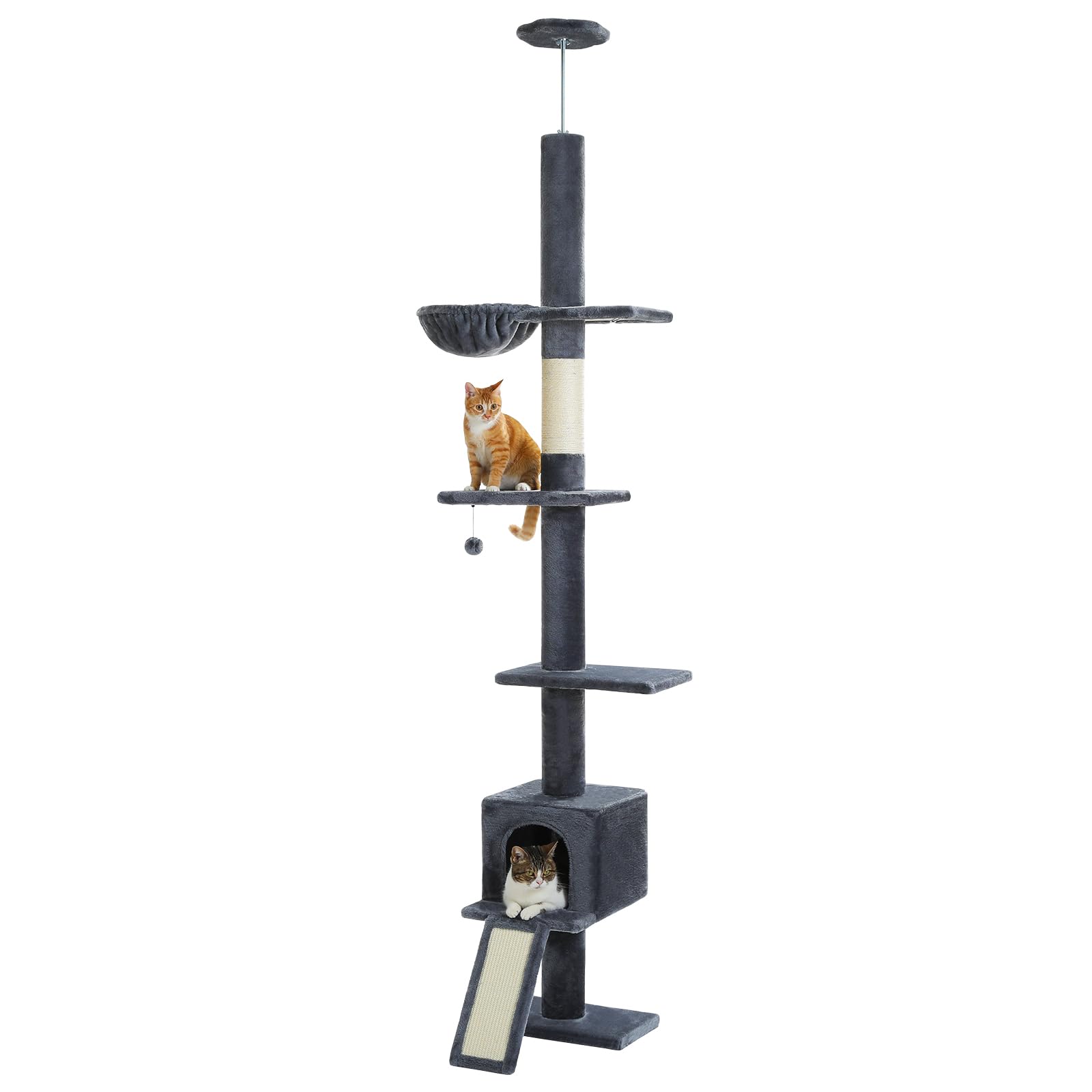
PEQULTI 5-Level Cat Tree

Tight budgets

Our Score 9.0/10
Check Price

Worth Noting

  • Condo and basket sized for small or average cats
Levels
5
Footprint
15.8 x 9.5 in
Height Range
82–108 in
Post Diameter
3.6 in
Read the full review

The least expensive of the four by a wide margin, and nothing about standing in front of it feels like a compromise: five levels, a condo, a hammock and 3.6-inch sisal posts on a base that measures 15.8 by 9.5 inches. That base is the detail that wins arguments in a small apartment — it slots into the gap beside a door in a way the 23-inch-deep FUKUMARU simply can't.

Stability comes from the base plus a scratching ladder that braces the lower half, and it does more work than the price suggests. The ceiling extension is the fiddly part; get the tension even on both sides and the whole tower stiffens noticeably. Rushing that last section is the one thing that makes this tree feel cheaper than it is.

Where it gives ground is cat size. The condo, the basket and most of the perches are cut for small and average cats, and a large cat will claim the top platform and ignore the rest. The care label also asks for dry cleaning, an odd fit for cat furniture, so plan on spot cleaning the faux fur. One practical note we picked up: the top section goes on far easier with a second person holding the tower steady.

Bottom line: The one we reach for when the budget is the constraint: it spans the ceiling, gets cats climbing, and fits a corner that the bigger trees can't.

2

Veehoo Adjustable Cat Tower

Veehoo Adjustable Cat Tower

Very tall ceilings

Our Score 9.0/10
Check Price

Worth Noting

  • 18.5 kg tower is awkward to raise alone
Weight
40.8 lb
Footprint
15.7 x 15.7 in
Height Range
102–122 in
Support Column
4.5 in
Read the full review

At 122 inches this is the tallest tree in the group, and the only one that clears a ten-foot ceiling with room to spare. If your room tops out at 118 or 120 inches, the others simply don't reach — that alone earns it a place on this list.

The build looks the part: a 4.5-inch support column and a heavy base, the sort of mass that shouldn't move. The top brace holds; the sway comes between levels, when a cat launches from one shelf to the next and sets the tower rocking. We squared ours into a corner and seated the base hard against the baseboard, and the difference was obvious.

The perches are generous enough that a large cat can lie flat rather than balance, and two capsules plus a woven basket give a multi-cat household somewhere to spread out. Sisal wraps the posts full length, not just the middles, so the scratching surface is where a cat actually reaches. It's the priciest tree here, and the ceiling is what you're paying for.

Bottom line: The pick for a room with ten-foot ceilings: the tallest tree here and the deepest support column, provided the ceiling is the reason you're shopping.

3

TQEW Floor-to-Ceiling Cat Tree

TQEW Floor-to-Ceiling Cat Tree

Most homes

Our Score 8.8/10
Check Price

Worth Noting

  • Capsule and small perches tight for big cats
Frame
Pine, PVC, sisal
Weight
33 lb
Height Range
55–119 in
Post Diameter
12 cm
Read the full review

Three threaded support rods pressing into the ceiling are the reason this one sits at the top of our list. A tension tree lives or dies at that joint — a single skinny pole with a spring will hold a cat, but it flexes, and flex is what makes a cat hesitate before it commits to the jump. Spreading the load across the top platform, plus 33 pounds of tree at the base, is a combination we trust more than anything else in this group. The 12-centimeter sisal posts help too: they're noticeably thicker than the 3.6-inch ones on our value pick.

Height is the quiet advantage. It adjusts from 55 to 119 inches, the widest spread here, so it settles into a low-ceilinged basement room as readily as under a nine-foot ceiling. Eight sisal posts in different lengths come in the box, which means you can shuffle the platform order to suit the cat rather than the other way around — higher shelves for a jumper, closer steps for an older cat working its way up.

Assembly is straightforward: the tools are in the box, and the install video is worth watching before the top brace goes on. Our one reservation is size rather than structure. The capsule and a couple of the smaller perches are tight for a big cat, so set the wider shelves higher up, where a heavy cat will actually settle.

Bottom line: For most homes this is the floor-to-ceiling tree we point to first: a genuinely solid ceiling brace, thick sisal, and a height range that fits nearly any room.

4

FUKUMARU 6-Level Cat Tree

FUKUMARU 6-Level Cat Tree

Large cats

Our Score 8.8/10
Check Price

Worth Noting

  • Shallow top bowl that cats tend to skip
Frame
Rubber wood plywood, jute
Levels
6
Footprint
33 x 23 in
Height Range
6–10 ft
Read the full review

Depth is what separates this tree from the rest of the group. The boards run 33 by 23 inches overall, which gives a cat room to turn around and stretch out rather than perch with its tail hanging over the edge. If you've watched a big cat try to fold itself onto a narrow shelf and give up, that difference is the whole purchase.

It reaches from 6 to 10 feet using three reinforced screw rods at the top rather than a single sprung pole, and it does it without a drill, which is why it's the one we point to for a nine- or ten-foot ceiling. The trade-off sits at that same joint: the tensioning bolts can work loose over a few months, so put a hand on them whenever you're up there dusting the top board.

The rest of the upkeep is easy. Pads come off for the washing machine, the boards wipe clean, and the jute-wrapped posts take a serious clawing. Where it stumbles is the round bowl near the top — it's shallow enough that cats tend to bypass it entirely, and the flat shelves do the real work. Buy it for the platforms, not the bowl.

Bottom line: If your cat is a big one, this is the tree we name: the deepest platforms in the group, and a six-to-ten-foot span that goes up without a drill.

How We Chose and Tested Floor-to-Ceiling Cat Trees

Every tree here started as research rather than luck: I pulled options across tension-mounted and wall-anchored designs, then filtered out anything that couldn't reach a standard eight-foot ceiling without an extra kit, anything with a footprint too wide for a corner, and anything priced out of proportion to what it's made of. That left eleven trees, which we set up in living rooms, a bedroom corner, and one genuinely narrow hallway nook, and lived with for eight months.

Before each one went up, I measured the ceiling and then checked whether the tree actually reached it — several claim a range they don't quite hit. Assembly was timed solo, using only the hardware in the box, and I wrote down exactly where the instructions lost me. Then came the shove test: a firm push against a mid-level platform to see how far the top swayed, followed by the real thing, a cat launching off the highest perch.

We tracked which platforms got used and which sat empty for weeks, and whether the top perch became a favorite spot or a one-time visit. Sisal and fabric got vacuumed weekly, and I ran a lint roller over the covers to see how much hair came up and whether anything pilled. Each tree was also judged against the room around it — some read as furniture, others as carpeted scaffolding — and against its price, including whether the mounting hardware came in the box.

How to Choose Floor-To-Ceiling Cat Trees

Measure the ceiling, then read the range honestly

These trees are tension-mounted, so height range is a hard filter rather than a suggestion. Measure floor to ceiling in the exact spot you have in mind and leave an inch or two of adjustment in reserve — a tree rated to 108 inches under a 108-inch ceiling is already maxed out with nothing left to tighten against. Most of the group tops out between 108 and 122 inches, which covers eight- to ten-foot rooms. The surface matters as much as the number: flat and solid, never a vault.

What actually keeps it standing

Two things hold a tension tree steady, and neither is the number of perches. The brace at the ceiling carries the load, so look for spread support rather than a single sprung pole; the mass at the bottom keeps it from skating when a cat lands. A narrow base concentrates weight on a small patch of hardwood, while a wider, heavier footprint spreads it. Placement is free stability too — square the tower into a corner where you have one, and seat the base flat before you tighten the top.

Platforms, perches, and the size of your cat

The most consistent letdown in this category is a perch a big cat can't lie on. Depth matters more than the level count: a 23-inch board gives a cat room to stretch out, while a nine-inch shelf is somewhere to balance. Measure your cat curled up, nose to tail base, and hold that against perch depth before you buy. Two cats need two perches they both fit on, not five they have to share.

Sisal, upkeep, and the parts that loosen

Scratching surface is where inexpensive trees show their age. Sisal wrapped along the full post holds up better than carpet-covered boards, which shred at the corners a cat actually uses. Check what comes off for cleaning — machine-washable pads and wipeable boards keep a tree in the room longer than a dry-clean-only cover. And expect to re-tension: the top joint settles in the first week and can work loose over months, so a ten-second check with each vacuuming is worth it.

Frequently Asked Questions

Final Verdict

Our pick for most homes is the TQEW. Three support rods spreading the load, 12-centimeter sisal posts and a 55-to-119-inch range add up to a tree that fits the room you have and doesn't flinch when a cat hits the top shelf at speed.

If your cat is on the large side, the FUKUMARU is the better buy for about the same money: 23-inch-deep boards and a six-to-ten-foot span, with the caveat that the top bolts want checking every few weeks. And if the trouble is your ceiling rather than your cat, the Veehoo's 122 inches is the only reach here that clears ten feet.