Grooming

Best Deshedding Tools for Cats of 2026

A deshedding tool is a short row of fine metal teeth that slips past the topcoat and lifts loose undercoat before it ends up on the sofa — the fix for the fur that reappears ten minutes after you vacuum. The difference between one that works and one that gets buried in a drawer comes down to the edge, the handle, and whether your cat will sit still for it. I have a long-haired cat who treats brushing like a personal insult, so I've learned to introduce new tools slowly.

Over the past four months, we put 14 tools through a full shedding season. The teeth mattered more than the price tag: a cheap one with evenly spaced, sharp teeth beat a heavier model whose wide blade skated over the coat without grabbing anything. And no tool is worth much if the cat won't tolerate it, so we watched for flinching and tail flicks as closely as we watched the pile of fur grow. The picks below earned a spot in the drawer rather than the closet, and the ones that give up their fur in a single peel got there fastest.

1

Swihauk Self Cleaning Slicker Brush

Top Pick
Swihauk Self Cleaning Slicker Brush

Most cats

Our Score 9.2/10
Check Price

Worth Noting

  • Short pins need extra passes on dense coats
Handle
Non-slip TPR
Cleaning
Push-button bristle retraction
Pin Tips
Rounded plastic caps
Coat Types
Long and short hair
Read the full review

Press the pad on the back of the Swihauk's head and the pins sink into the housing, leaving the collected fur sitting on top as a loose pad you can lift off with two fingers. That's the whole idea, and it works: no picking strands out of bristles, no damp paper towel, no fur drifting onto the floor while you clean the brush. The pins are stainless steel with rounded plastic caps, set into a head that stays flat against a cat's back.

For a cat, the tip is the entire argument. A pinned brush with sharp ends gets a flinch, and a flinch ends that session and often the next one; these caps glide over the spine and ribs, and the pins are short enough that nothing digs in when the cat shifts. We hand this one to people brushing a cat for the first time, and to anyone whose cat grants about a minute before walking off. The TPR handle earns its place too — it stays grippy once your palm is furred up, which happens quickly.

What it doesn't do is reach the bottom of a heavy coat. On a dense winter undercoat the pins skim the surface and you'll work the same strip several times, and the head is wide enough that the flanks take some steering. On an ordinary short or medium coat, one pass lifts the loosened fur and the button clears it, and that brush-press-brush rhythm is why this one lives by the door rather than in the drawer with the rest.

Bottom line: If you want one brush that a cat will sit still for, this is it: rounded pins, a head that empties with one press, and enough reach for an ordinary undercoat.

2

FURminator Grooming Rake

FURminator Grooming Rake

Dense double coats

Our Score 9.2/10
Check Price

Worth Noting

  • Teeth spaced for dense coats, not fine hair
  • Wide head is clumsy around face and legs
Teeth
Rotating metal
Weight
6.56 oz
Best Coats
Thick, dense double coats
Dimensions
6.5 x 2 x 9.65 inches
Read the full review

A cat with a real double coat is a different grooming problem from a tabby with a sleek one. The FURminator rake is aimed squarely at that animal: a head of rotating metal teeth on a non-slip handle, sized for a body with a lot of fur to move.

The teeth rotate as they travel, so the head follows the lie of the coat instead of fighting it, and they're spaced widely enough to get under dense fur rather than skating across the top. Work in short strokes along the spine and over the britches and the undercoat comes up in soft rolls. The handle is the part we noticed most: it stays planted even when the coat is dragging at the teeth.

This is the tool we keep for a genuinely heavy coat, and the one that rewards a light hand more than any other pick here. Two or three passes over an area is plenty; keep going and you're brushing skin, not fur. On the right cat it lifts in one sitting what a slicker takes a week to gather, and that's the trade — real depth, used carefully.

Bottom line: The tool for a genuinely dense double coat — a Maine Coon, a Norwegian Forest Cat, a cat that leaves fur on every surface — as long as you keep your strokes light.

3

Gonicc PDT-1001 De-Shedding Comb

Gonicc PDT-1001 De-Shedding Comb

Fine long hair

Our Score 9.2/10
Check Price

Worth Noting

  • Head detaches for cleaning rather than self-clearing
Storage
Protective cover and eyelet
Cleaning
Push-button detachable head
Comb Steel
2.6 inch stainless steel
Power Source
Manual
Read the full review

This is the plainest tool in the group and the one we've kept using the longest. It's a comb — stainless teeth on a plastic handle, with a button that releases the head — and it does the unglamorous thing well: it lifts loose fur out of a fine, long coat without the scraping sensation that sends a cat out of the room.

The teeth are close-set and fine, so the coat comes up in soft rolls rather than clumps, and a cat with a silkier long coat tolerates it in a way it won't tolerate a rake. The protective cover is a small thing we've come to value, since fine steel teeth loose in a drawer are a hazard for hands, and the eyelet at the end means it can hang instead of rattling around.

It's slow on a dense double coat: the teeth fill quickly and you'll clear them every few strokes, which is the price of fine teeth. And on a short, sleek coat it finds very little, because there isn't much loose undercoat for it to catch. Where it earns its place is the long-haired cat that mats easily and hates being tugged.

Bottom line: Our pick for fine, long hair that mats easily: a fine-tooth comb that lifts loose fur without tugging, on a head you can detach and store.

4

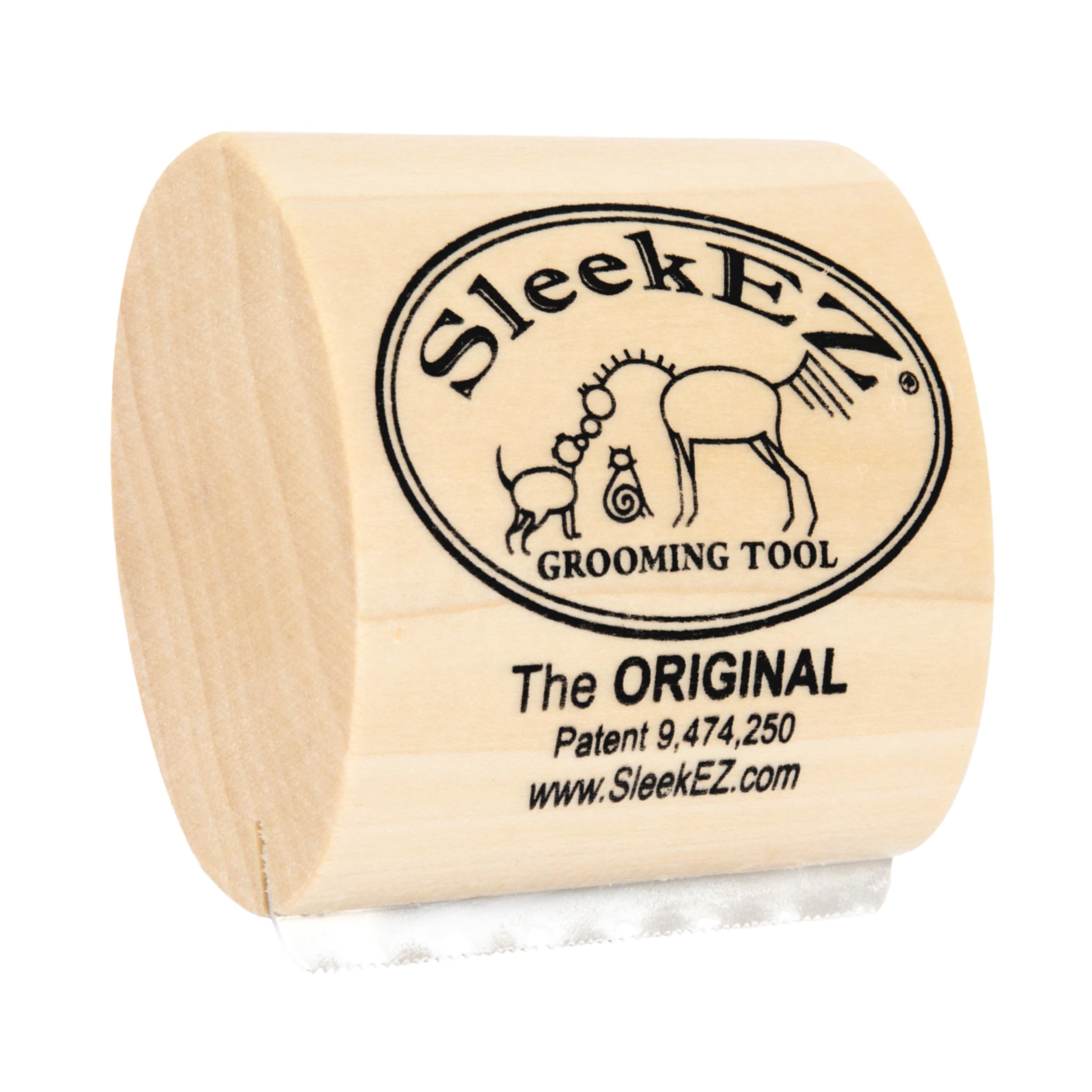
SleekEZ Cat Brush

SleekEZ Cat Brush

Short-haired cats

Our Score 9.0/10
Check Price

Worth Noting

  • Fur has to be wiped off the blade by hand
Weight
2 oz
Coat Types
Short, medium and long
Dimensions
5.5 x 3 x 1.5 inches
Also Lifts Hair From
Carpets and cat trees
Read the full review

The SleekEZ doesn't look like a brush. It's a two-ounce strip of toothed metal on a plastic handle, and the first pass down a cat's back comes with a certain amount of brace — you expect a complaint that doesn't arrive. There are no pins to dig in, because there are no pins at all.

This is the tool we choose for a short-haired cat, and for the cat that has already decided brushes are suspicious. A domestic shorthair's shed comes off in sheets, gathering in a visible line along the blade, and the small head — 5.5 by 3 inches — slips under a chin or along a tail without the bulk of a slicker getting in the way. Cats that object to the scratch of metal pins generally don't object to this.

The second job is what keeps it out of the drawer. The same edge pulls embedded cat hair out of carpet, fleece, and the top of a cat tree, and during shedding season we reach for it on the sofa about as often as on the cat. That's a bonus rather than a reason to buy, but it's why this one lives somewhere accessible.

Bottom line: Buy it if your cat flinches at pinned brushes. This thin blade lifts loose undercoat from short and medium coats and does a second job on the sofa.

5

Depets Self Cleaning Slicker Brush

Depets Self Cleaning Slicker Brush

Budget brushing

Our Score 9.0/10
Check Price

Worth Noting

  • Soft pins skim over a thick undercoat
Handle
Comfort-grip nonslip
Weight
3.53 oz
Cleaning
One-click release
Pin Tips
Rounded beads
Read the full review

The Depets is the least expensive brush in this group, and on an ordinary short-to-medium coat it behaves like brushes that ask for more. The head is a standard slicker with rounded pin tips, the grip is soft, and the button on the back pushes the collected fur off in one movement so you can get back to brushing.

What it has going for it with cats is softness. We found the pins give when they meet resistance, and a cat that flinches at a stiffer brush will often settle for this one; the massage it provides is why some cats start arriving when they hear the drawer open. You do need a light hand and a few passes rather than pressure — leaning on it doesn't get more fur out, it just flattens the coat.

The honest summary is that this is the brush to buy when you don't yet know whether your cat will cooperate. It's the least expensive way to find out, it's genuinely usable if the answer is yes, and if the coat turns out to be thicker than expected you'll know within a week and can spend more later. For a first cat and a normal coat, this is enough.

Bottom line: The brush to buy when you don't yet know whether your cat will tolerate brushing — soft pins, a one-push head, and the lowest price here.

6

Docrok Grooming Combo

Docrok Grooming Combo

Matted coats

Our Score 9.0/10
Check Price

Worth Noting

  • Two tools take more drawer space than one
Teeth
Stainless steel
Handle
Lightweight TPR
Includes
Grooming brush and metal comb
Rake Sides
Wide and dense
Read the full review

Mats are the reason people give up and book a groomer. They form behind the ears, under the front legs, and along the britches, and a slicker works around them rather than through them. The Docrok set is the only pick here built for that job: a rake and a comb, both double-sided.

Wide teeth on one edge open a knot; the dense edge on the other side pulls loose undercoat out of a coat that's already clear. The teeth are stainless steel and set firmly enough that there's no flex when you meet resistance, which is what we want in a mat tool — a springy tooth skates off the knot instead of opening it.

A comb turns out to be the piece that gets used more than expected. Wide side for smoothing, dense side for the loose fur around the head, legs, and tail, the places a rake is too broad to reach. Both tools share a lightweight TPR handle, so a longer session doesn't leave your hand cramped.

Buy this when the coat has already started to mat, or when you're steering a long-haired cat through a seasonal blow and want one purchase covering both jobs. On a well-kept shorthair it's more tool than you need, and two handles take twice the drawer space of one.

Bottom line: Choose it when the coat has already matted: the wide rake side opens a knot and the dense comb finishes, in one purchase.

7

MIU COLOR Pet Grooming Brush

MIU COLOR Pet Grooming Brush

First blade tool

Our Score 9.0/10
Check Price

Worth Noting

  • Handle is the least comfortable in this group
Comb
4 inch stainless steel
Head
Detachable with safety cover
Handle
Anti-slip
Weight
3.53 oz
Read the full review

A blade tool with a cover is a small thing that matters in a house with cats: the MIU COLOR's head snaps shut under a plastic guard, so it can sit in a drawer without you reaching onto exposed steel teeth. Under the cover is a 4-inch stainless comb on a detachable head, sized like a slim brush rather than a rake.

Used flat against the coat with light strokes, the teeth pick up the loose undercoat a slicker leaves behind, and the shed gathers along the blade in a line. It does the same job as the SleekEZ in a different shape — teeth set in a head rather than a bare strip, which makes it easier to grip and slightly less nimble around the shoulders.

The detachable head is the practical part: release it and the comb rinses under a tap, faster than picking fur out of pins. The catch is capacity. On a dense coat it fills quickly and you'll be clearing it every few strokes, so it suits an ordinary undercoat better than a cat in full winter wool.

At the bottom of this group on price, it's the sensible first blade: cheap enough to try, gentle enough for a cat that dislikes pins, and easy to live with because it cleans under a tap. It's the one we hand to someone who wants to try the technique before spending more, and on a short-coated cat it does nearly everything the pricier blades do.

Bottom line: The cheapest way into a blade-style deshedder: a guarded comb head that reaches loose undercoat and rinses clean under a tap.

8

Aumuca Cat Brush

Aumuca Cat Brush

Long-haired cats

Our Score 8.8/10
Check Price

Worth Noting

  • Priced above plain slickers for a similar plastic build
Size
4.05 x 1.54 x 9.64 inches
Cleaning
One-click shutter release
Pin Tips
Round rubber
Pin Angle
150-degree bent needles
Read the full review

Most brushes in this group are dog tools with a cat photo on the box; the Aumuca is bent the other way, with pins set at an angle instead of straight out of the head. That angle is why it's our pick for long-haired cats: the pins follow the lie of the coat rather than dragging across it, so you can work a ruff or a set of trouser feathers without bearing down. The tips are rubber-capped, which matters more on a cat's thin skin than on a dog's, and it's a large part of why a wary cat gives this one a second session.

Click the button and a plate travels forward, separating the fur from the pins so it comes off in one piece. We found that faster than picking a slicker clean by hand, and it means a multi-cat house moves from one animal to the next without a detour to the trash.

Where it gives ground is on short, single coats. The angled pins are built to travel through length, and on a sleek tabby they mostly polish the topcoat instead of pulling undercoat out, which a straight-pinned slicker or a blade does better. On the coat it was built for, though, it's the most efficient brush in this set.

Bottom line: We recommend this for long-haired cats whose coats need real depth: the angled, rubber-tipped pins get under a heavy coat, and the shutter clears them in one click.

How We Tested, and How the Cats Weighed In

We started with every deshedding tool that kept turning up in owner reviews and on shelter grooming shelves, then narrowed the field by tooth spacing, blade material, handle shape, and whether replacement blades or strips were sold separately. That left 14 tools — blade-style deshedders, comb-style rakes, and a couple of glove-style models — all bought at retail like anyone else would. Each one spent four months in a two-cat household, on a shorthair and a longhair, and got used the way people actually use these things: on the living room rug on a Sunday morning, after dinner while the cat was drowsy, and once during a warm week when the fur came off in tufts.

Every session ran five minutes on the clock. We counted strokes before the tool loaded up, weighed the fur we pulled off, and checked the skin afterward for redness or scratches, because a dull edge pulls, and a pulling tool ends the session early. Cats vote with their feet: we noted which tools made ours lean in and purr versus which drew a tail flick and a walk-off in under a minute, then retested the losers a week later to rule out a bad mood.

Cleaning is where the field split hardest. Some tools release their fur in one satisfying peel; others trapped it between the teeth and needed a comb and a rinse every few strokes. We rinsed each one after use and checked at the one-month and four-month marks for rust, bent teeth, and loosened handles. Value came down to the boring stuff — whether the teeth held their edge, whether a replacement blade was available, and whether the tool still felt worth its price after a full season of Sundays.

How to Choose Deshedding Tools for Cats

Start With the Coat You Actually Have

Run a hand along the flank against the grain. If the coat parts and shows a dense, woolly layer beneath the guard hairs, you're dealing with a double coat, and a rake or a deep-reaching slicker earns its keep. If the fur is fine and long, a close-set comb does more than pins. If the coat is short and sleek, the shed sits on the surface and a blade lifts it in a couple of passes.

Buying for the coat in front of you rather than the one on the box is most of the decision. A heavy-coated cat and a sleek tabby need different tools, and no single brush is best at both.

Pins, Blades, and Teeth Reach Different Depths

A slicker's pins work the top centimeter or so of coat, which is where most loose cat fur sits, and rounded tips keep that comfortable. A blade rides the surface and gathers what's already loose. A rake or a wide-tooth comb gets underneath a dense undercoat, which is the only way to make a real difference on a heavy-coated cat during a seasonal blow.

Depth costs tolerance: the deeper a tool reaches, the more precisely it has to be used. That's why the gentlest pick here is a slicker and the most effective on a heavy coat is a rake.

Fit the Tool to a Cat's Body

A cat's brushable area is small — spine, flanks, chest, britches — and a head sized for a Labrador covers half of it in one stroke, which makes steering around shoulders and hips awkward. Look for a head you can angle under a chin and turn along a tail, and a weight that doesn't tire your wrist over a five-minute session.

Wide heads are faster on big dogs and clumsier on cats. This is one place where smaller genuinely wins.

Cleaning Is What Keeps a Tool in Rotation

Every tool collects fur, and the one that empties fastest is the one you'll still be using in a month. Retracting-pin heads push the fur off in a pad; a blade wipes clean in a single pass; a fine comb needs the fur picked out, and on some models the head comes off first.

Check how it stores, too. A cover over the teeth makes a comb or blade safe to keep in a drawer instead of on a shelf out of reach.

Mats Need a Different Tool and a Slower Hand

A mat is felted fur, and no slicker will get through it. Start with the wide side of a rake or comb at the outer edge, work inward in small sections, and hold the skin flat so you're not pulling it. A rigid stainless tooth opens a knot; a springy one skates over it.

If the mat sits tight against the skin, or the cat won't tolerate the work, stop and let a groomer take it off. Never cut at a mat with scissors.

Frequently Asked Questions

Final Verdict

For most cat households, the Swihauk is the tool to buy. The rounded pins are why a cat sits through a session, the push-button head is why you'll actually use it every other day, and it isn't the most expensive tool here.

If the coat is long and heavy, the Aumuca's angled pins do more per stroke. If it's short and the cat is wary of pins, the SleekEZ asks for less trust. Start from the coat and the cat, and the choice makes itself.