Grooming

Best Cat Toothbrushes of 2026

A cat's mouth is roughly the size of a walnut, but the hand holding the brush is full-size, and that mismatch is where most home dental routines fall apart. The head has to be small enough to slip past a cheek and reach the back molars, the handle long enough to keep your fingers out of the bite zone, and the bristles soft enough that a nervous cat doesn't flinch and write off the whole ritual. Get those three things wrong and the brush joins the nail clippers in the drawer nobody opens.

What a good one buys you isn't cosmetic, either. A few brushing sessions a week is the cheapest dental care your cat will ever get — far cheaper than the scaling procedure your vet will eventually bring up. I've brushed my own cats' teeth for years, and over the past three months my team and I worked through 15 toothbrushes with cats ranging from patient to openly hostile. The surprise was how little the brush design mattered compared with the toothpaste: most cats quit over flavor, not bristles, so settle on a paste they'll accept first and then worry about what's on the other end of it.

1

H&H Pets Cat Toothbrush 8-Pack

Top Pick
H&H Pets Cat Toothbrush 8-Pack

Most cats

Our Score 9.2/10
Check Price

Worth Noting

  • Bristle tips splay with steady use
Count
8 brushes
Bristles
Ultra-soft, human-grade
Head Size
Extra small
Brush Style
Standard handle
Read the full review

A cat's mouth is small enough that plenty of pet toothbrushes feel like a broom handle with bristles on the end. The H&H set earns its place on the head alone: genuinely extra small, short enough to sit against the back molars without prying the jaw open, and narrow enough to work along the gumline of a cat that isn't holding still for you.

What makes it our default rather than just a good small brush is the count. Eight brushes for about what one premium pick costs here means a splayed brush gets retired without a second thought, and for a cat that needs brushing most days, replacing the brush is the habit that quietly falls apart first.

The bristles are billed as human-grade ultra-soft, and we set expectations there rather than call them the softest in this guide. They're gentle enough for daily work on most cats, but a cat that flinches and turns away at the first touch does better with the finer microfiber on the JAYU; come back to these once the routine is established.

Eight also means one can live wherever you actually brush, by the bathroom sink, in the travel bag, in the kitchen drawer you pass on the way out, and the plain handle rinses clean and stands up to dry without trapping water.

Bottom line: Our default pick: eight genuinely cat-sized brushes with soft bristles, inexpensive enough that retiring a splayed one never feels like a decision.

2

Qubccum 8-Piece Cat Toothbrush Kit

Qubccum 8-Piece Cat Toothbrush Kit

Fussy cats

Our Score 9.2/10
Check Price

Worth Noting

  • Includes firm-bristled brushes a cat may refuse
Count
8 brushes
Bristles
Silicone and microfiber
Contents
Mixed brush styles
Read the full review

If you've already bought two brushes your cat won't let near its face, this kit is the cheaper way to stop guessing. Eight brushes arrive in one box in several shapes: a round 360-degree head, small silicone brushes, a tapered mini head, a silicone finger brush, a very fine-bristled brush, and a dual-head.

That spread is the point. Acceptance is individual, and a cat that clamps its mouth shut for a nylon brush will sometimes sit still for a finger brush it can chew, while another will only tolerate the round head. You can't predict which from a photo.

So use it as a trial rather than a set. Give each shape a few days, keep the one your cat leans into, and don't force the rest. The pieces we've kept in rotation are the round head and the finger brush; the others sit in the drawer, and that's fine.

What you're buying is an answer rather than a toothbrush collection. For about what a single premium brush costs here, you find out which shape your cat will sit through, and then you buy that shape in a proper pack instead of collecting more maybes.

Bottom line: The kit we suggest when you don't yet know what your cat will accept: eight shapes to try, and one of them will stick.

3

C.E.T. Pet Toothbrush

C.E.T. Pet Toothbrush

Simple single brush

Our Score 9.2/10
Check Price

Worth Noting

  • Bristles feel firmer than a soft label suggests
Head
Small oval
Count
1 brush
Length
7 inches
Bristles
Soft nylon
Read the full review

Next to the micro-head brushes in this guide, the C.E.T. looks almost stubbornly ordinary: one small oval head on a straight plastic handle, sold loose. The head is what earns it a place, small enough for a cat's mouth and slim enough that you can work along the outside of the back teeth without the handle levering against a canine.

What we noticed first is how little there is to it. No case, no second head, no eight-pack: you buy one brush, use it until the bristles go, and buy another. For a single cat that has already accepted brushing, that's all a toothbrush needs to be, and it's the version that goes in a travel kit without a second thought.

Bottom line: A plain, small-headed brush that fits a cat's mouth and does the job without extras, for anyone who wants one brush rather than a system.

4

Pet Republique Dual-Head 6-Pack

Pet Republique Dual-Head 6-Pack

Long-handled reach

Our Score 9.2/10
Check Price

Worth Noting

  • Bristles run firm for a cat
Count
6 brushes
Heads
Dual, small and large
Handle
Long
Read the full review

Half of this brush isn't for your cat. The dual-head design puts a small brush on one end and a large one on the other, and the large end is dog-sized; on a cat you'll use the small head for every stroke and ignore the rest.

The long handle is the part that earns it a spot. It keeps your fingers outside the bite zone while the small head works the molars, which matters with a cat that likes to test whether your hand is part of the deal. We also check the head after each session, since the bristles can shed and a loose bristle in a cat's mouth is the one thing here worth watching.

Six brushes to a pack is the other half of the argument: one for the bathroom, one for the pet bag, one for the car, and no worry about where they end up. It's the set to buy for a multi-cat house where brushes vanish.

Bottom line: We buy it for the long handle and the six-pack, knowing only the small end will ever go in a cat's mouth.

5

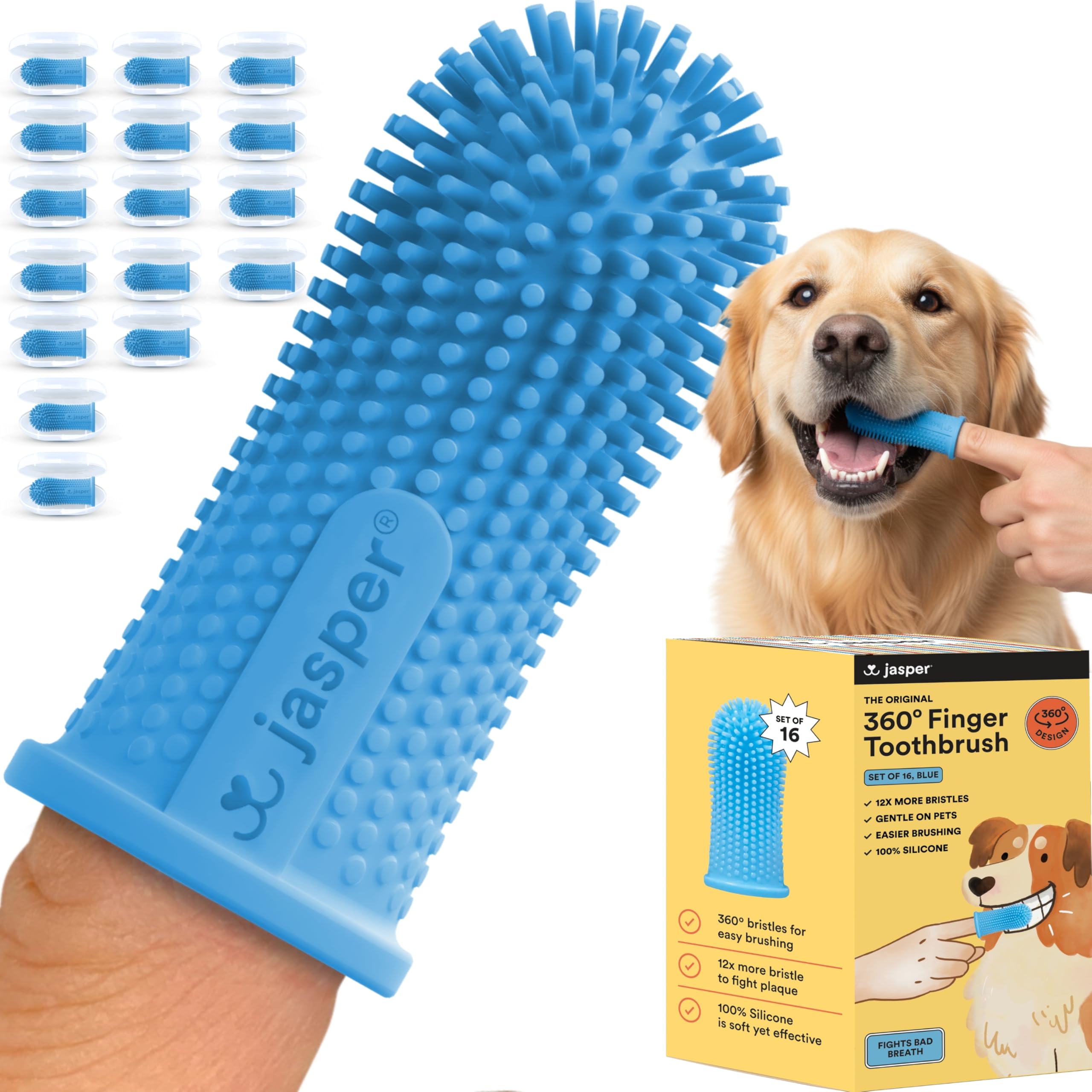
Jasper 360° Finger Toothbrush 16-Pack

Jasper 360° Finger Toothbrush 16-Pack

Finger-brush fans

Our Score 9.0/10
Check Price

Worth Noting

  • Bulky inside a small cat's mouth
  • Sixteen is more than a one-cat house needs
Care
Dishwasher-safe
Count
16 finger brushes
Bristles
360° all-around
Material
Food-grade silicone
Read the full review

A finger brush trades reach for feedback. With the silicone sleeve over your index finger you can feel the tooth through the material, the ridge of a molar or the edge of a canine, which is how you know you're on the tooth and not the gum. The Jasper version covers the finger on all sides with soft nubs, so the angle you come in at matters less.

It's also the bulkiest option here. A finger plus a layer of silicone is a lot to fit between a cat's cheek and its back teeth, and a small-mouthed cat will notice. A cat with a narrow muzzle does better with one of the slim handled brushes in this guide.

Where it wins is with cats that chew. The silicone gives under a bite, so a cat that grabs the brush does some of the cleaning itself, and the nubs are on every surface. Each brush is rated for six to twelve months of daily use; with a determined chewer we treat that as the best case.

Sixteen brushes, each with a storage case, makes the outlay sensible in a two-cat house and ridiculous in a one-cat one. The case is the part we underrated: a finger brush that lives loose in a drawer picks up lint and hair between uses, and this one doesn't.

Bottom line: For a cat that chews the brush more than it tolerates it, this silicone sleeve gives you feel and gives the cat something soft to bite.

6

RYERCAT Dual-Sided Cat Toothbrush

RYERCAT Dual-Sided Cat Toothbrush

Tiny mouths

Our Score 8.8/10
Check Price

Worth Noting

  • Premium price for a two-pack
  • Fine bristles splay with daily use
Head
Dual-sided micro head
Count
2 brushes
Handle
Biodegradable cornstarch
Bristles
Soft
Read the full review

The dual-sided micro head is the smallest in this set, small enough to lie flat against a cat's upper front teeth and slip behind the last premolar without the cat gagging on it. That head is what you're paying for, and for a cat with a genuinely tiny mouth it's the difference between brushing and wrestling.

Size changes technique more than you'd expect. With a head this small you work tooth by tooth in short strokes, which suits a cat that tolerates a few seconds and then leaves. We also came around on the two colors: in a two-cat house they settle whose brush is whose without a label.

The handle is a cornstarch-based material rather than plastic, and it stays rigid enough to steer that tiny head into place rather than flexing away when the cat turns its head.

Bottom line: We recommend it for one reason: the smallest head in this set, which is exactly what a genuinely tiny mouth needs.

7

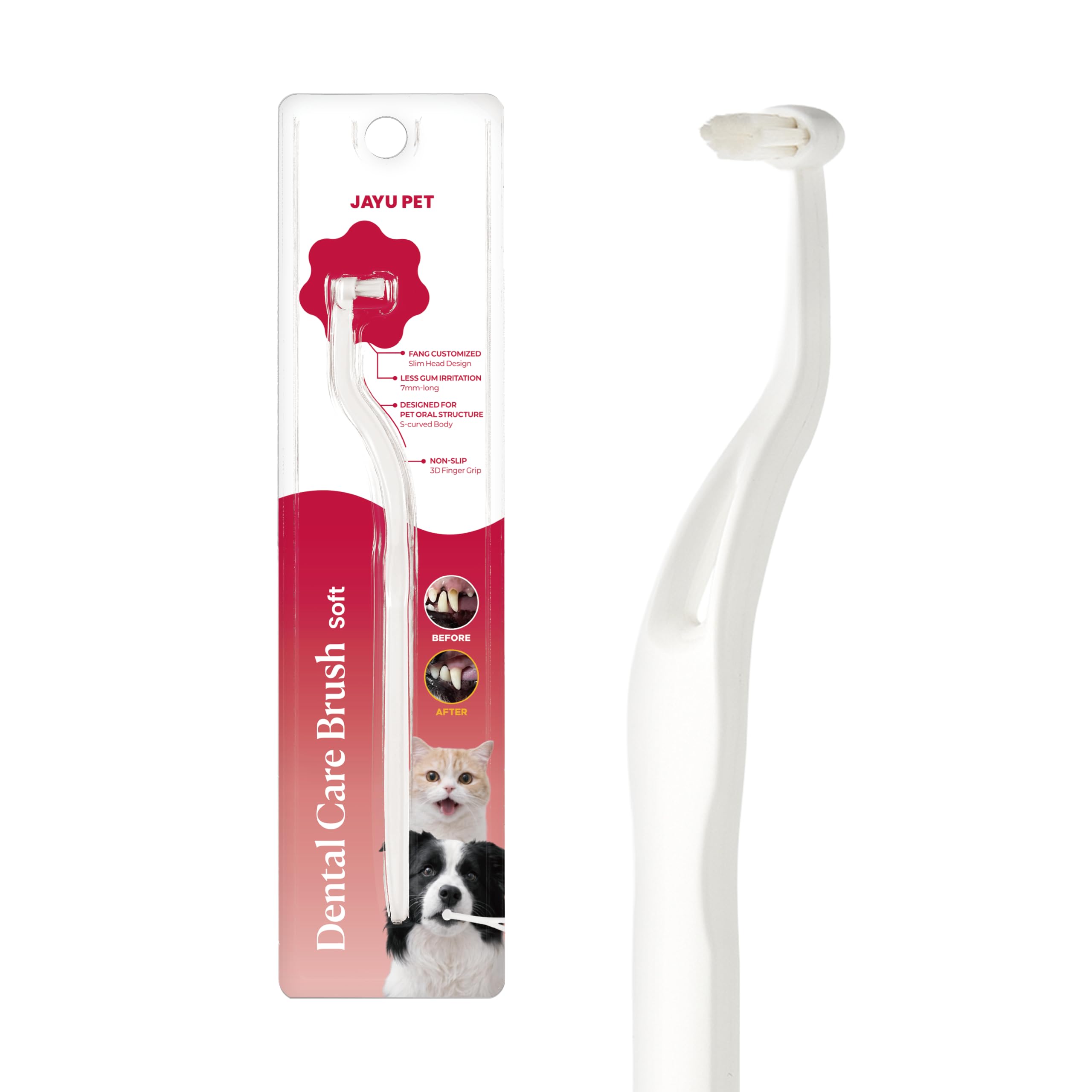
JAYU PET Dental Care Brush

JAYU PET Dental Care Brush

Brush-shy cats

Our Score 8.8/10
Check Price

Worth Noting

  • Sold singly, so there is no spare
Head
Horizontal
Count
1 brush
Length
6.89 inches
Bristles
0.10 mm microfiber PBT
Read the full review

The figure that matters on the JAYU brush is 0.10 mm, the gauge of its PBT microfiber bristles, which puts the feel closer to a soft makeup brush than to the nylon most pet toothbrushes use. On a kitten, or a cat that has never had anything in its mouth, there is nothing there to catch on the gumline.

The shape does as much work as the bristles. The body is S-curved with a horizontal head, so your hand sits below the cat's eye line and the bristles lie flat along the outside of the teeth instead of poking at them end-on. We found that geometry made the upper back molars noticeably easier to reach, and those are the teeth that are hardest to get to and easiest to neglect.

Bottom line: Where we start with a kitten or a brush-shy cat: the finest bristles in this set and a curved body that keeps your hand out of the argument.

8

E.M&S.T 360° Silicone Cat Toothbrush

E.M&S.T 360° Silicone Cat Toothbrush

Cats that bite

Our Score 8.8/10
Check Price

Worth Noting

  • Head is too big for kittens and very small cats
Head
360° silicone nubs
Count
2 brushes
Extras
Suction-cup holder
Head Length
0.67 inches
Read the full review

The first time a cat clamped down on this brush mid-stroke, nothing happened, and that's the whole argument for it. The head is soft silicone covered in 360-degree nubs rather than nylon bristles, so a cat that bites and gnaws is working the brush against its own teeth instead of driving bristles into its gum.

Because the nubs wrap the whole head, there's no good side to find: you can come at a tooth from the front, the side or underneath and it still cleans. That's less for a wriggling cat to object to, and it shortens the session, which is worth more than it sounds.

The suction-cup base is the detail we didn't expect to use. Wetted and pressed onto a glossy sink or tile it holds the brush upright and off the counter between sessions; on a matte or textured surface it slides, which is worth knowing before you rely on it. This is the one we reach for with the cat that fights, because it's the one that has needed the least coaxing.

Bottom line: Our pick for a cat that bites the brush: soft silicone turns chewing into cleaning, and the suction base keeps the head off the counter.

How We Tested 15 Cat Toothbrushes (and Kept All Our Fingers)

We started with two veterinarians and one question: what actually matters when you're brushing a cat at home? The answer was reaching the gumline rather than scrubbing the crown of the tooth. From there we built a shortlist from veterinary dental brands, pet supply staples, and the finger brushes owners keep recommending to each other, then filtered by head width, handle length, bristle stiffness, whether replacement heads are sold separately, and cost across a year of use.

That left 15 toothbrushes, each assigned to one cat in one household for three months, used at the same time every evening. Sessions happened wherever the cat allowed them — on the bathroom counter, in someone's lap, or on the floor with a towel wrap for the cat who treats brushing like a wrestling match. Our testers ran from a five-month-old kitten to a 12-year-old with early gum disease, so every brush got tried on a small mouth and a sore one.

We judged softness by gum reaction rather than by feel: whether the gumline turned pink afterward, whether the cat pulled away mid-brush, whether we saw blood on the paste. Fit came down to how far back we could reach before a cheek stopped us. Every two weeks we inspected each brush for splayed or bent bristles, heads that had worked loose, and handles chewed by the cat who insists on helping. Ease of use was really a question of whether one hand could hold an angle while the other held a cat, and value meant comparing replacement heads against buying a whole new brush. Pet preference broke the ties: a brush a cat tolerated twice beat one with better specs that ended the routine for good.

How to Choose Cat Toothbrushes

Start With the Head, Not the Handle

Head size decides more than any other number here. A head that is too long levers the jaw open and ends the session on the first stroke, because a cat's cheek teeth sit close together at the back of a very small mouth. The 0.67-inch silicone head on our pick for biters is about the largest we are comfortable putting in a cat, and kittens do better with smaller.

If a brush is sold with two heads, the small one is the cat end. Everything else about the brush is secondary to whether that head will sit flat against a tooth without the cat objecting.

Softness You Can Test Before You Buy

Labels are unreliable on this: soft turns up on brushes whose bristles feel like a firm human brush. You can settle it at the kitchen table in five seconds by running the bristles across the inside of your wrist. If it scratches, it will scratch a cat's gumline, and the cat will remember.

Material tells you most of the rest. Nylon is the firmest option in this guide, microfiber the finest, and silicone sits apart because it does not scrape at all, which is why chewers do well with it.

Handled, Finger, or 360-Degree Silicone

Each style trades reach against control. A handled brush gets your fingers out of the mouth and reaches the molars, but you are working blind at the end of a stick. A finger brush puts your fingertip on the tooth so you can feel what you are doing, at the cost of bulk inside a small mouth. A 360-degree silicone head cleans from any angle and survives being chewed.

Match it to the cat in front of you: a biter wants silicone, a head-shy cat often wants the finger brush, and a cat that already sits still rewards a small handled brush.

Count, Replacement, and the Jumbo-Pack Trap

Bristles splay and stiffen with use, and a splayed brush cleans less and feels worse to the cat, so replacement should be cheap and unthinking. That is the real argument for multipacks, several of which cost about what one premium brush does.

The trap is buying eight of a brush your cat has never seen. Buy a single brush or a mixed kit first, find the shape and softness your cat accepts, then buy that one by the pack.

Frequently Asked Questions

Final Verdict

Start with the H&H eight-pack. The heads are small enough for a cat's back teeth, the bristles are gentle enough for daily work, and having eight means you replace a splayed brush instead of rationing it. Change that recommendation on two conditions: a genuinely tiny mouth calls for the RYERCAT micro head, and a cat that flinches at the first touch does better with the JAYU's finer bristles.

Everything else on this list is a decision about style and control, not about fit or softness. Those three cover almost every cat in a normal house.