Beds & Furniture

Best Cat Scratcher Lounges of 2026

The fear with any cat scratcher is the same every time: you carry it home, set it down, and your cat sniffs it once before strolling over to shred the arm of your couch. A scratcher lounge is the attempt to solve both problems in one piece of furniture — a corrugated surface long enough for a full-body stretch, shaped so a cat can also flop down on it afterward. Get the right one and the couch gets a break; get the wrong one and you've spent money on an expensive bed your cat will ignore.

I've learned the hard way that cats don't care how a scratcher looks. They care whether it stays still when they dig in, whether the surface has enough grip to catch a claw, and whether the thing is already in the spot where they like to nap. Over the past six months my team and I have lived with 12 of these lounges in homes with cats ranging from a five-month-old kitten to a very set-in-her-ways fifteen-year-old, and the differences in who used what were not subtle. The picks below are the ones the cats actually chose — and the ones that were still holding up when the others had gone to shreds.

1

Scratch Lounge XL

Top Pick
Scratch Lounge XL

Stretching out

Our Score 9.6/10
Check Price

Worth Noting

  • Premium price for a corrugated bed
Extras
Catnip included
Weight
2 lb
Lounge Size
22"L x 13"W x 5"H
Scratch Surface
Reversible corrugated insert
Read the full review

Twenty-two inches is the number that settles this one for us. The other loungers here give a cat 16 or 17 inches of flat surface — fine for a curled sleeper, tight for a cat that likes to lie out with a leg dangling. The extra length, on a 13-inch-wide bed, is what lets a big cat stretch from nose to tail on corrugated board instead of on the carpet. It is the product we hand to anyone who wants one scratcher-bed and no further decisions.

The insert is the other half of the argument. It is reversible, so when one face is chewed into a nest of shreds you flip it and start again on a fresh surface. That is a second life out of the same box, and it is the difference between a bed that lasts one season and one that lasts two. A packet of catnip comes in the box, and a pinch worked into the corrugation is how we get a hesitant cat onto a new bed the first evening.

What the design gives up is containment. The bed is open rather than walled, so shreds end up on the floor around it, and a cat that likes to burrow will pick the Hide & Scratch box instead. Neither has bothered the cats we have watched use it — they sprawl, then sleep — but the open shape is a choice, not an oversight.

Bottom line: Our default pick: 22 inches of flat cardboard long enough for a cat to stretch out on, with an insert that flips for a second life. Buy it first.
2

Conlun Oval Scratcher Bed

Conlun Oval Scratcher Bed

Curlers

Our Score 9.6/10
Check Price

Worth Noting

  • 16.9 inches is short for long or heavy cats
Care
Spot clean only
Shape
Oval, concave
Patterns
Five options
Lounge Size
16.9"L x 12.9"W x 3.5"H
Read the full review

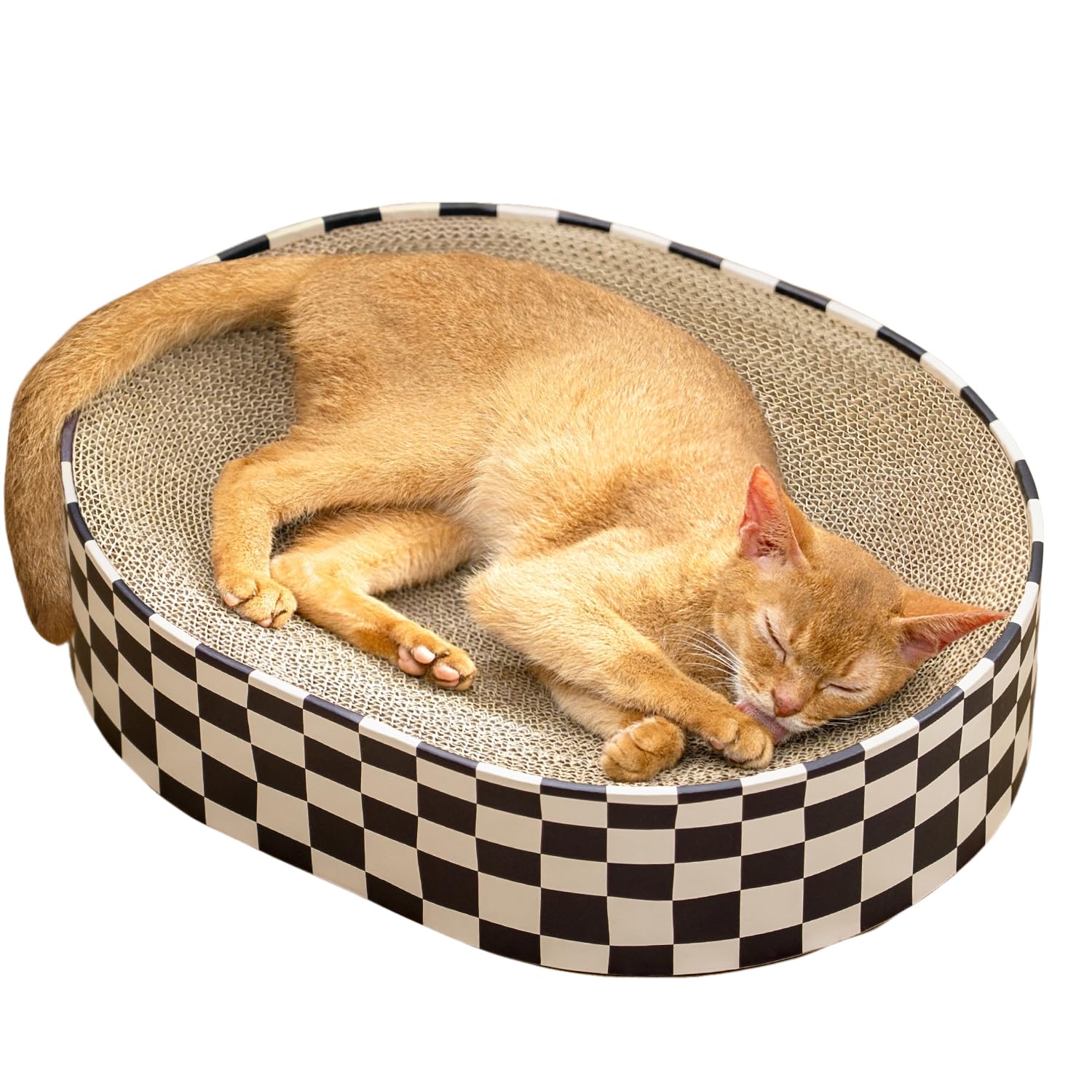
A cat that sleeps curled wants a bowl, not a mattress. This one is 16.9 by 12.9 inches with a shallow 3.5-inch rim, and the concave floor lets a cat sink into the middle with its chin propped on the edge — the shape a cat picks when it is settling in for hours rather than stretching out.

That shape is why it is our pick for sleepers. A curved bed holds a cat in place, so an animal that rearranges itself three times before it settles has less to rearrange. The corrugated surface underneath is dense and recycled, and it takes the scratching from the same cat that naps on it — nothing separate to buy, nothing to assemble, out of the box and onto the floor.

Five pattern options mean it can be matched to a room rather than apologized for, and the low profile slides under a coffee table or beside a sofa without blocking anything. Cleaning is spot work with a damp cloth; corrugated board and water do not mix, so resist the urge to rinse it in the sink.

Bottom line: Our pick for the cat that sleeps curled into a comma: a shallow oval bowl that cradles the body, takes a daily scratching, and needs no assembly at all.

3

FUKUMARU Cat Scratcher Bed

FUKUMARU Cat Scratcher Bed

Large cats

Our Score 9.4/10
Check Price

Worth Noting

  • One cat at a time in an 11.2-inch bed
Extras
Two bell balls on a cord
Material
Corrugated paper and felt
Lounge Size
26"L x 11.2"W x 7.9"H
Scratch Surfaces
Two reversible boards
Read the full review

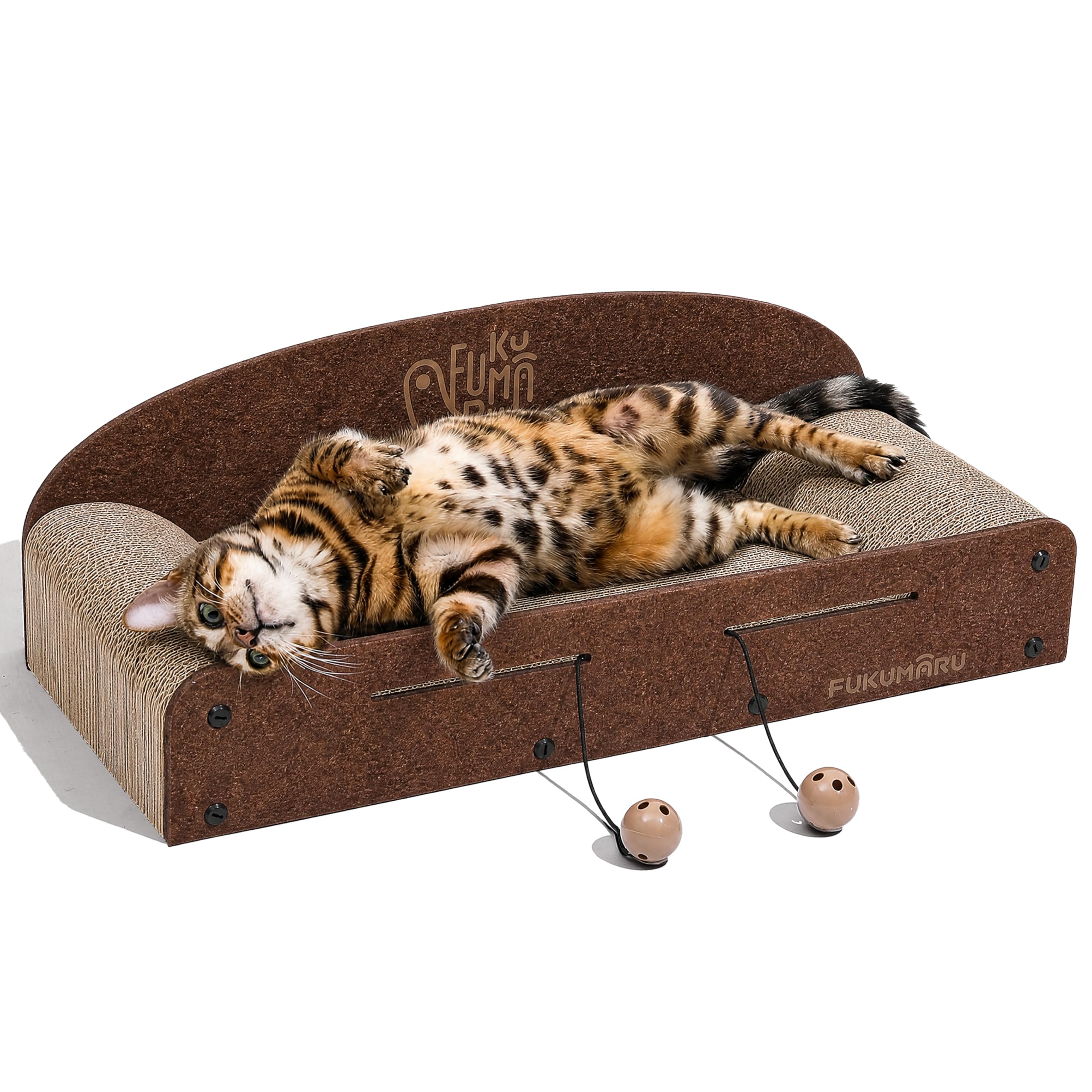
Two bell balls dangle from an elastic cord across the front of this bed, and they do more work than a toy usually does on a scratcher: they are what pulls a cat across the room in the first place. The rest of the design is why it stays.

The bed measures 26 inches long and 7.9 inches tall, with curved felt edges raised on both sides. What we did not expect is how much those edges change the shape of the thing — they give a cat a place to rest its chin instead of spilling over the side. Inside sit two corrugated boards, each usable on both faces and stackable, which works out to four fresh scratching surfaces. It slots together in a few minutes and the felt holds its shape once it is up.

Big cats are the reason we recommend it. The 26-inch length and 11.2-inch body take an 18- or 20-pound cat without the squashed look a bowl gives you, and the semi-enclosed shape suits a cat that likes to feel covered without being shut in a box. The boards are the part that wears, and there are two of them, so the frame should outlast its scratching surface.

Bottom line: Our pick for a big cat: a 26-inch bed with felt edges to lean on and two double-sided boards inside, so there are four scratching surfaces before you buy anything else.

4

Hide & Scratch Scratcher Box

Hide & Scratch Scratcher Box

Cats who hide

Our Score 9.4/10
Check Price

Worth Noting

  • Ships with one pad; order a refill early
Weight
1.4 lb
Material
Corrugated cardboard
Lounge Size
16"L x 13"W x 7.5"H
Scratch Pad
Double-sided, replaceable
Read the full review

It is a box, and that is the whole idea. The sides stand 7.5 inches tall — high enough for a cat to hunker down out of sight — and the floor of the box is a corrugated scratch pad rather than plain cardboard. For a cat that has never met a bed it liked, this is the shape we recommend first.

Two details make it better than the shipping box it resembles. The pad is double-sided, so it flips when the first face is done, and it is replaceable rather than the entire bed being disposable. The box itself is thick corrugated board held with plant-based glue and printed with soy-based ink, which matters in a house with a cardboard chewer. Sticky feet in the box keep it from skating on hardwood.

Sixteen by thirteen inches is snug for a very large cat — a 20-pounder fills it to the walls — and that is the trade for a box a cat can actually disappear into. The walls earn their keep a second way, too: most of what gets torn off stays inside rather than on the rug.

Bottom line: If your cat treats beds as furniture and boxes as home, this is the pick: 7.5-inch walls to duck behind, a reversible pad in the floor, and a two-minute setup.

5

FluffyDream 2-in-1 Lounger

FluffyDream 2-in-1 Lounger

Living rooms

Our Score 9.4/10
Check Price

Worth Noting

  • Narrow 9.45-inch sleeping channel
Pieces
Two nesting boards
Material
Five-layer corrugated cardboard
Lounge Size
27.56"L x 9.45"W x 8.86"H
Scratch Surface
Reversible, vertical and horizontal
Read the full review

The box holds two curved pieces, not one. Nested together they make a lounger with a cutout at each end; pulled apart, each piece becomes its own scratcher, which is how one purchase ends up in two rooms. Assembled, it runs 27.56 inches long — long enough for a large cat to stretch out along one piece.

The finish is what sold us on it for a living room. The cardboard is pressed and shaped into an arc that reads as mid-century furniture, which makes it the pick here most likely to pass as something you chose rather than something you tolerate. The surfaces work vertically and horizontally, so a cat can dig in at an angle, and both pieces are reversible.

How long it lasts depends on your cat. Light scratching leaves the five-layer board intact for months; a determined digger can shred a piece within days, and a hollow section can crack through the middle. We buy it for the shape and the second surface and treat the board as the consumable part it is.

Bottom line: Two curved pieces that nest into one lounger or split into two scratchers, with a look that passes as furniture. The board is the wildcard, so treat it as consumable.

6

PatiencET Scratcher Box Set

PatiencET Scratcher Box Set

Small cats

Our Score 9.4/10
Check Price

Worth Noting

  • Too narrow for average and large cats
Catnip
Four packets
Box Size
17.3"L x 8.8"W x 5.5"H
Pads Included
Four, double-sided
Read the full review

Four pads, one box, four packets of catnip. That is the pitch, and it is why this set is in the guide: the pads are the part that wears out, so buying four at once costs less over a year than replacing a whole bed every time a surface goes.

Each pad is double-sided, which makes for eight scratching surfaces in total, and the pads sit inside the box rather than beside it. That matters more than it sounds. The 5.5-inch walls keep most of the crumbs in one place, and refreshing the bed means swapping a pad, not sweeping the room.

The box measures 17.3 by 8.8 inches, and the width is the limit. A small or medium cat curls up in it happily; an average or large cat spills over the sides, and a 15-pounder will not sleep in it at all. Nothing about the build is flimsy — it is just sized for one small animal.

Where it earns its place is the second location: a bedroom, a kitten's first bed, the patch of sun by the window where a cat already naps. Four pads cover a year of scratching in a room you do not want to sweep twice a day, and the box takes up less floor than any other pick here.

Bottom line: Four double-sided pads and a box that catches the shreds make this the best refill value here, provided your cat is small or medium and does not need to sprawl.

7

Petlinks Dream Curl

Petlinks Dream Curl

Carpet scratchers

Our Score 9.4/10
Check Price

Worth Noting

  • Feather toy wears out before the rest
Size
11"L x 6.5"W x 17.75"H
Extras
Feather toy on a cord
Weight
5.6 oz
Materials
Carpet and sisal
Read the full review

Cardboard is not for every cat, and this is the pick for the ones who walk past it. The Dream Curl is wrapped in carpet with a sisal panel, and a change of texture is the first thing we try with a cat that has ignored every corrugated pad in the house.

The shape is a wave: 17.75 inches tall, curling over so a cat can rake up the face, lie along the crest, or slide into the gap underneath. A feathery toy dangles from the side for cats that need an invitation, and at 5.6 ounces the whole thing lifts with one hand when you want it in another room.

It is 11 inches long and 6.5 inches deep, so it is not a lounge the way the Scratch Lounge is. A big cat drapes over it rather than lying in it, and the listed measurements are worth checking against your own cat before you count on it as a bed.

Small apartments, a corner too tight for a full lounger, a household where cardboard has already failed twice — that is where this one makes sense. It gives a cat three things to do, scratch and perch and hide, in about the space of a doormat.

Bottom line: The pick for a cat that walks past cardboard: carpet on one side, sisal on the other, shaped into a curl cats drape over. Small, so it is a perch rather than a bed.

8

PetFusion Jumbo Scratcher Lounge

PetFusion Jumbo Scratcher Lounge

Multi-cat homes

Our Score 9.2/10
Check Price

Worth Noting

  • A serious outlay for cardboard
Levels
Two tiers
Weight
11.2 lb
Assembly
None required
Lounge Size
14"L x 11"W x 39"H
Read the full review

Two cats, one piece of furniture. The Jumbo is 39 inches long and split into two levels, so one cat flattens out along the top curve while another tucks into the hollow underneath — which is how it gets used in a house with more than one cat, and why it holds a spot here that the flat beds cannot.

Sturdiness is what separates it for us. At 11.2 pounds it is the heaviest thing in this guide, and the weight is the point: heavy-duty corrugated that does not skate when a cat leans into a scratch and does not sag in the middle when two of them sit on it at once. It also arrives built, which sounds like a small thing until you have slotted together a bed with a cat already trying to climb into it.

The cost is floor space. Thirty-nine inches along a wall is a lot to give a cat bed, and this one will not tuck into the corner the way a 17-inch box does. One average cat in a small apartment does better with the Scratch Lounge and half the footprint. Two cats that compete for the best sleeping spot are exactly who this was built for, and the length is what ends the argument.

Bottom line: For a two- or three-cat household, this 39-inch two-tier lounge is the one we point to: one cat on top, another in the hollow, and no wobble under either.

How We Tested the Cat Scratcher Lounges

We started by pulling together every lounge we could find from brands with a track record in cat furniture, then narrowed the field by the things that matter before a cat ever touches the product: whether the pad was long enough for an average adult cat to stretch out flat, whether replacement pads were sold separately and at what cost per refill, and whether the base had any grip on the bottom. Anything that slid across hardwood with a light push got cut. That left us with 12 units, which we placed in real homes for six months.

Placement was deliberate. Each lounge went where cats already spent time — beside a couch arm, in a home office, in front of a sunny window — and the first 48 hours were mostly observation. We noted which cats approached on their own, which ones sniffed and walked away, and which ignored it entirely until day three. We also left the couch unprotected, which felt reckless but told us a lot about which surface a cat chose when both were available.

Scratching performance got messier. We swept up the loose cardboard each lounge shed in a week and noted the difference between a pad that crumbled and one that held its corrugation. We flipped each one over to check whether the base had shifted, and we watched where claws actually landed — the cats that scratched flat versus the ones that reared up and dug in at an angle told us whether a longer pad was worth it. At the end of six months we checked which pads had been clawed through to the base and how many refills each one had needed.

The rest came down to the cats. We tracked which lounges got slept on versus only scratched, whether the older cat claimed one permanently, and whether the kitten used hers as a launchpad for ambushes. Value landed where it always does with cat furniture: the cheapest lounge that survived six months of daily use cost less than two replacements of the one that shredded in eight weeks.

How to Choose Cat Scratcher Lounges

Measure the resting surface, not the box

Listings quote the footprint; your cat measures the part it can actually lie on. A curled sleeper is comfortable in a 16- or 17-inch oval, a cat that stretches out flat wants something closer to 22 inches, and a two-cat household should be looking at the 39-inch jumbo. The trap is the word large in a title: a 13-inch bowl is a kitten bed however the listing describes it.

Measure your cat from chest to rump, add a few inches, and compare that against the lounge's length and width rather than its overall box size. A bed that fits exactly is a bed a cat will use once and leave.

Count the scratchable surfaces

Corrugated cardboard is a consumable, so the question isn't whether a lounge will wear out but how many fresh surfaces you get first. A single-faced pad is finished when one side is shredded; a reversible insert buys a second run at it, and two double-sided boards give you four.

That arithmetic matters more than the price on the tag, because a bed with four surfaces beats a cheaper one you replace twice. Check whether the pads are replaceable too: a frame that takes refills outlives one that doesn't.

Decide whether you want walls

Walled boxes and semi-enclosed beds suit cats that like to hide, and the walls keep most of the shreds inside the bed instead of on the rug. Open flats let a cat sprawl in any direction and step in without a threshold, which is why a cautious cat often takes to them faster.

There's no universally better shape. A burrower will ignore a flat bed for months, and a sprawler will hang out of a box. Match the shape to the way your cat already sleeps on the sofa.

Check how it sits on your floor

A lounge that slides mid-scratch is a lounge the cat abandons. Heavier beds stay put on hardwood, and some come with sticky feet or a textured base to help; thin trays can skate across tile when a cat pushes off. Texture is worth a thought too, since a cat that ignores cardboard may take to carpet or sisal.

And because this piece lives in a room rather than a closet, the finish counts. Several picks here are shaped and colored to pass as furniture rather than announce themselves as cat gear.

Frequently Asked Questions

Final Verdict

The Scratch Lounge XL is the one we tell people to buy first. Twenty-two inches of flat cardboard with a reversible insert is the most dependable shape here for a cat that scratches and sleeps in the same place, and it earns its premium price the moment your cat picks it over the sofa arm.

If two cats compete for the best spot, the PetFusion Jumbo ends that argument with a second level. If your cat wants to feel covered while it sleeps, the FUKUMARU gives it walls, four scratching surfaces, and room for a 20-pound body. Everything else here is a variation on those three decisions.