Cleaning & Odor

Best Cat Scratch Tape and Couch Protectors of 2026

There's a particular sound that stops a cat owner cold: the slow rip of claws through upholstery. Cat scratch tape is the stopgap—a clear, double-sided sheet or strip that makes the spots your cat loves feel tacky and unpleasant, so they move on to the scratching post instead. It won't train your cat by itself, and it won't fix every couch, but it protects the furniture you already have while you redirect the behavior.

I've tried the cheap rolls that peel up in a day, and I've tried the ones that leave a gummy mess on linen. Over the past three months, my team and I applied 16 different tapes to sofa arms, chair legs, and doorframes—then lived with them, and two very determined cats, long enough to see which ones actually stayed put. The best ones share a boring trait: they're easy to cut cleanly and press flat, so the cat can't get a claw under an edge. The picks below are the ones that survived daily life—and the occasional full-speed launch.

1

Panther Armor Furniture Protector 8-Pack

Top Pick
Panther Armor Furniture Protector 8-Pack

Whole-sofa coverage

Our Score 8.8/10
Check Price

Worth Noting

  • Glossy finish catches light on dark upholstery
Warranty
30 days
Attachment
Single-sided self-adhesive
Sheet Sizes
4 XL at 12 x 17 in, 4 large at 10 x 17 in
Sheets Per Pack
8
Read the full review

Eight sheets is more coverage than it sounds. Four measure 12 by 17 inches and four measure 10 by 17, which adds up to about 1,500 square inches — enough for the back panel and both arms of a standard sofa, with the smaller pieces left over for the chair by the window.

What makes us recommend this pack first is the size split rather than the count. A six-pack of identical extra-large sheets forces you to cut one down for a chair arm and waste the offcut; here you reach for a 10-inch piece and keep the big panels for the places a cat can really dig in. The film is flexible enough to follow a rolled arm without creasing, and it stays clear once it's pressed down.

The hold is where it asks for faith. These are single-sided, self-adhesive sheets, so nothing but the glue keeps them on, and on a loose weave or a curved arm that gets leaned on, an edge can lift. Wiping the fabric dry and smoothing from the middle outward is the difference between a sheet that stays flat and one that curls at the corner.

What it won't do is teach. A cat meets a smooth surface, loses interest in that panel, and takes the lesson no further — the top of the sofa and the door frame are still fair game. For a cat with one committed corner and a habit worth breaking, a sticky tape gets you there faster.

Bottom line: The pack we recommend to most people: two sheet sizes, about 1,500 square inches of clear film, and an install you can finish before your cat notices the new couch.
2

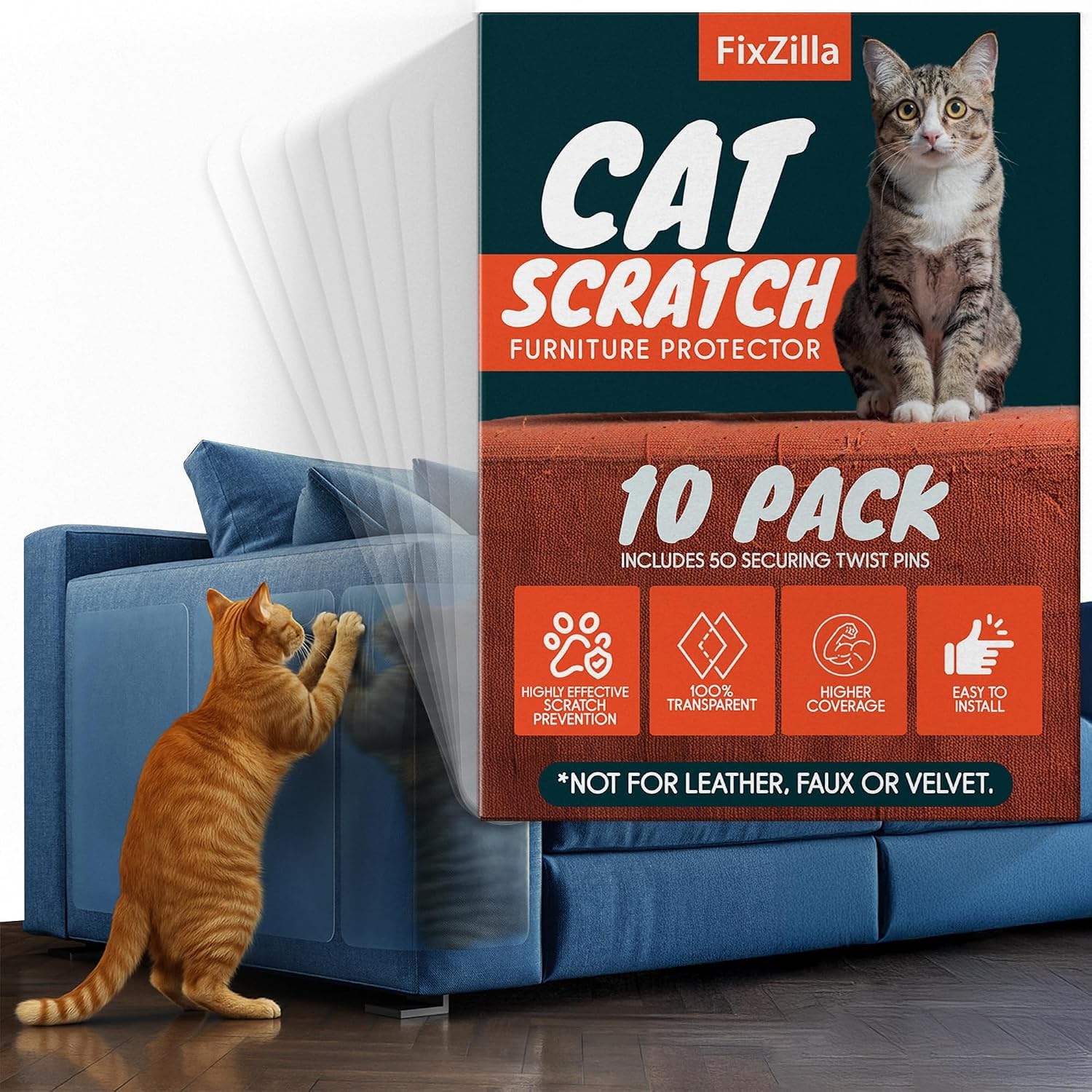
FixZilla Cat Scratch Protector 10-Pack

FixZilla Cat Scratch Protector 10-Pack

Arms and corners

Our Score 8.8/10
Check Price

Worth Noting

  • Not for velvet, microfiber, faux leather, or leather
Hardware
50 twist pins
Warranty
90 days
Fabric Note
Not for velvet, microfiber, faux leather, or leather
Pieces Per Pack
10 (7 panels, 3 corner strips)
Read the full review

Fifty twist pins is the number that earns this pack its place. They screw into the upholstery and hold the film on exactly the spots where a flat adhesive sheet gives up: the front of a rolled arm, the top of a chair back, the corner a cat launches itself from.

The pieces are cut for that work. Seven are 17 by 12 inches and three are 17 by 6 corner strips, so you can wrap an arm rather than butt two rectangles together at the bend. Totaled up it's more film than our top pick, spread across more pieces and therefore more seams — tidy on a flat panel, busier on a curve.

We preferred it in the room where the damage was concentrated on chair arms, and the pins did what glue couldn't. The maker's own caveat is worth knowing: some cats pull the twist pins out, and the pins are optional, so on a cat that has figured them out you're back to the adhesive, which holds less on a curve. Buy it for the shape of your furniture, not because more hardware sounds better.

Bottom line: When the damage is up on the arms and corners, the pins here hold the film where glue alone won't — that's the reason to pick it over a plain sheet pack.

3

Lovinch Clear Vinyl Protector Roll

Lovinch Clear Vinyl Protector Roll

Long flat panels

Our Score 8.8/10
Check Price

Worth Noting

  • Not recommended on leather or faux leather
Warranty
180 days
Roll Size
160 x 12.4 in
Thickness
0.12 mm vinyl
Attachment
Single-sided, removable
Read the full review

A roll changes the job. Instead of fitting rectangles around a sofa arm, you measure one length, cut along the grid printed on the backing, and run a single strip down the side of the couch or across the top of a headboard.

At 160 inches long and 12.4 inches wide, one roll covers a sofa side twice over with enough left for an ottoman. The vinyl is 0.12mm, and the extra body over thinner film shows at the arm cap, where a cat puts its weight before it pulls.

It's single-sided and stays that way, which makes this armor rather than training: a cat that likes the spot will find the unpeeled end if you stop short. Wiping the fabric dry before you peel the backing makes a real difference — dust and lint are what let an edge lift.

For a long flat panel, we haven't found a reason to reach for a stack of sheets instead. Where sheets win is curves: a roll gives you straight edges and a scissors problem, and wrapping a rolled arm neatly takes more patience than pressing on a pre-cut corner piece.

Bottom line: For a whole sofa side or a headboard, one continuous strip beats a stack of rectangles — this is the roll we reach for when the damage runs in a line.

4

Sofisti-Cat Training Tape

Sofisti-Cat Training Tape

Training a cat

Our Score 8.6/10
Check Price

Worth Noting

  • Narrow 2.5-inch width means several strips per arm
Material
Polyethylene
Roll Size
2.5 in x 15 yd (540 in)
Tape Type
Double-sided, clear
Read the full review

A clear vinyl sheet blocks a claw; tape changes the decision behind it. Cats dislike the feel of a tacky surface under their paws, so a double-sided strip on a couch arm is a lesson rather than a wall, and this 2.5-inch by 15-yard roll is the one we keep coming back to for that job.

Fifteen yards goes further than it sounds, and on tight-weave upholstery the tape lies flat enough that visitors won't spot it from across the room. Lining up parallel strips without a bare sliver between them is the fiddly part, and starting the paper backing takes a fingernail.

Removal is where the caution belongs. The same grip that holds on a cotton cushion can lift fibers from a loose weave or a textured microfiber, so test a hidden patch first, as the maker also advises. Do that, leave the tape on the surfaces that can take it, and it does the one thing a barrier can't: the cat gives up on the couch and goes looking for the scratching post instead of a different corner.

Bottom line: For a cat that needs to learn rather than be blocked, this clear double-sided roll is the one we hand people first.

5

Secopad Cat Scratch Protector 18-Piece

Secopad Cat Scratch Protector 18-Piece

Multiple problem spots

Our Score 8.6/10
Check Price

Worth Noting

  • Adhesive alone can let go on loose weaves
Hardware
72 twist pins
Material
PET film
Sheet Sizes
17 x 12 in and 17 x 6 in
Pieces Per Pack
18 (12 panels, 6 corner strips)
Read the full review

Eighteen pieces and 72 pins is the largest count in this group, and that arithmetic is the argument. You can cover four couch corners, a door frame, and two arm caps without ever cutting into a panel you needed intact, which is why this is our pick for a house with more than one problem spot.

Twelve pieces are 17 by 12 inches and six are 17 by 6 corner strips, all in the same clear PET film — thin enough to disappear against most upholstery, stiff enough to press on without trapping air. The sheets lift away when you want to move one to a new spot, which happens more than you'd expect with a kitten.

The pins end up doing more of the work than the adhesive, and they go through the fabric: a few small holes in exchange for a hold that survives a cat leaning back on its hind legs. Pin the back and sides, where a hole won't show and nobody leans, and keep the adhesive for the cushions.

Bottom line: The piece count is the reason to buy: 18 sheets and 72 pins cover a whole house's worth of corners from one box.

6

Stelucca Amazing Shields 6-Pack

Stelucca Amazing Shields 6-Pack

Boxy furniture

Our Score 8.6/10
Check Price

Worth Noting

  • Pins can work loose from the fabric
Guarantee
Money-back
Thickness
1.2 mm PVC
Attachment
Adhesive pads plus twist pins
Sheets Per Pack
6 at 17 x 12 in
Read the full review

At 1.2mm, this sheet is roughly ten times the thickness of the heaviest vinyl roll in this group. That turns it into a rigid shield rather than a film — it doesn't curl at the edges, it doesn't wrinkle when a cat lands on it, and a claw skids across the surface instead of catching.

On the flat back panel of a sofa, we thought the stiffness was the whole point: it presses on, stays flat, and the clear PVC all but disappears against a mid-tone fabric. On a rolled arm it's less graceful, because a rigid sheet stands proud of a curve instead of following it, and the edge where the film ends becomes something you notice.

Six extra-large sheets with no small pieces, a self-adhesive pad plus twist pins for each, and a money-back guarantee that covers the case where your cat defeats the entire idea. If your furniture is boxy — a modern sofa, a bench, the flat side of a recliner — this is the most substantial protection here.

Bottom line: For flat, boxy furniture and a cat that hits hard, the rigid 1.2 mm shield is the most substantial protection here.

7

Polarduck Anti Cat Scratch Tape

Polarduck Anti Cat Scratch Tape

Doors and frames

Our Score 8.6/10
Check Price

Worth Noting

  • Can lift paint from painted trim on removal
Backing
Peel-off paper
Roll Size
4 in x 30 yd
Tape Type
Double-sided, clear
Read the full review

Four inches is the difference between one strip and two. On a couch arm, this roll covers in a single pass what a narrower tape needs a pair for, and 30 yards means you can run the full length of a sofa back without splicing in a new piece.

The catch is in your hands. A 4-inch strip of double-sided tape wants to fold onto itself, and separating the paper backing takes patience, so we cut shorter lengths than we first planned and lined them up — slower and tidier than wrestling a long run into place.

Where it earns its place is the surfaces a sheet can't wrap: door frames, the top of a baseboard, the edge of a carpet where a cat turns a corner. It's also the least forgiving thing here to remove, so start on the surfaces you don't mind testing.

Bottom line: The widest, longest tape here: one strip across a couch arm, or a full run down a door frame, without splicing.

How We Tested Cat Scratch Tape

We started by rounding up every cat scratch tape we could find in clear and colored versions, then cut the list by material, roll size, adhesive type, and whether the backing looked like it would peel cleanly. That left us with 16 tapes, which we tested for three months in the places cats actually target: sofa arms, dining chair legs, and a doorframe. My two cats served as the real judges—one heavy scratcher, one curious pawer—and I applied every strip myself so the setup was consistent.

Easy installation mattered more than I expected. I timed how long it took one person to cut and press a strip onto a curved sofa arm, and I noted whether the backing came off in one piece or tore into shreds. I pressed each strip for 30 seconds, then checked after 24 hours and again each week to see whether corners curled, edges lifted, or the tape slid out of place. The tapes that held on fabric also had to hold on wood; a few stuck beautifully to upholstery and gave up on a varnished chair leg.

To judge scratch resistance, I checked each surface for punctures, cloudiness, and lost tack after daily clawing, and I watched whether the cats avoided the taped spots or walked right over them. Durability showed up in smaller ways: rolls that split when unrolled, strips that stretched, adhesive that left a gummy line on linen. When I removed each tape after three months, I looked for residue, lifted finish, and pulled fibers. We also compared usable square footage per roll against how much we wasted when the backing stuck to itself—because value here is mostly about how far a roll actually goes.

How to Choose Cat Scratch Tape and Couch Protectors

Sticky Tape or Clear Barrier

Double-sided tape works on a cat's dislike of tacky paws. The cat reaches for the couch arm, meets something unpleasant, and backs off, and after a few repeats the spot loses its appeal. A single-sided vinyl sheet works differently: the surface is slick, the claw gets no purchase, and the cat learns nothing about the couch beyond that one panel. When the damage is recent and concentrated, start with tape. When the sofa is new and you want it armored today, film covers more area in one go and doesn't depend on the cat's mood.

How It Stays On

Adhesive alone is a gamble on upholstery. The sheet that grips a tight cotton weave can slide on a loose one, and no flat adhesive holds a rolled arm the way a pin does. That's why corner-focused packs such as FixZilla and Secopad ship with twist pins: they drive into the fabric and stay. The cost is small holes, so pin the back and sides and leave the seat cushions to adhesive or to nothing. Whatever you choose, wipe the fabric dry first — dust and lint are what let an edge curl.

Check the Fabric Before You Buy

Nearly every maker in this category prints the same exclusion list: no velvet, no microfiber, no faux leather, no leather. On those surfaces the adhesive grabs the nap instead of the weave, or bonds hard enough that removing it takes the finish with it. Test a hidden patch — behind the sofa, under a cushion, on the inside of a skirt — for a day before you cover anything visible. A leather sofa is better served by a throw or a fitted cover than by any tape here.

Sheets, Rolls, and Seams

A sheet pack covers ground in rectangles; a roll covers it in one piece. Every join between rectangles is a line a claw can find and a corner that can lift, which is why a long flat run suits the Lovinch roll better than a stack of panels. Pre-cut sheets win on arms and corners, where a shaped piece wraps better than anything you can cut by hand, and a corner strip saves you from folding a big sheet around a bend. Match the format to the shape of your furniture and the seams take care of themselves.

Frequently Asked Questions

Final Verdict

For most people the answer is the Panther Armor eight-pack. Two sheet sizes mean you aren't cutting a big panel down to fit a chair arm, the film is clear enough to leave up for months, and one pack covers the back and both arms of a normal sofa.

Pick differently if the damage is shaped differently. A cat working one curved arm needs the FixZilla pack's fifty twist pins, which hold where glue won't. A whole flat side or a headboard is a job for a roll, not rectangles. And if the goal is to change the habit rather than armor the couch, a double-sided training tape is the only thing here that teaches.