Health & Wellness

Best Cat Dental Water Additives of 2026

Ask a vet what's most likely to go wrong with a cat and teeth land near the top of the list. The gold-standard fix, brushing, is a two-person job most cats tolerate for about four seconds. Hence the appeal of a dental water additive: a few drops in the bowl and you're supposedly done. What it actually buys you is the unglamorous daily work — the breath you get a faceful of when they yawn, the tartar creeping along the gumline between cleanings — without turning dental care into a wrestling match.

My cat treats any change to her water bowl as a personal insult, so I started out skeptical. We spent four months with 14 additives, and the gap between a good one and a waste of money usually came down to whether our cats kept drinking. That's the part first-time buyers miss: a cat who backs off the bowl is a worse outcome than bad breath. The picks below are the ones that got drunk down — and the ones whose breath we could stand up close.

1

ZYMOX Oratene Water Additive

Top Pick
ZYMOX Oratene Water Additive

Enzymatic daily care

Our Score 9.0/10
Check Price

Worth Noting

  • Smallest bottle here at the highest price tier
Dose
Pump dispenser
Formula
Unflavored and enzymatic
Free From
Gluten, wheat, soy, dairy, artificial flavors
Bottle Size
8 fl oz
Read the full review

ZyMox takes a different route to the same bowl. Instead of a straightforward plaque-fighting liquid it's an enzymatic, brushless formula, and instead of a cap it uses a pump.

The pump is what we appreciate most. A capful is a blunt measure for a small bowl, and a pump delivers the same squirt every time — consistent from day to day and easy to keep light for a cat that seems unsure about the water. The liquid is unflavored and free of gluten, wheat, soy, dairy, and artificial flavors, which leaves very little for a cat to detect.

The label also points it at dry mouth, listing a cracked tongue, inflamed gums, and food aversions among what it supports. That's a more specific job than general breath freshening, though a cat showing those signs needs a vet's opinion before it needs a new bottle. For a single cat and a daily habit, the pump alone is reason enough to pick this over a capful.

Bottom line: A pump-dosed enzymatic formula that disappears into the bowl — worth the premium if you want a brushless additive aimed at plaque rather than breath alone.

2

Dry Element Pet Water Care

Dry Element Pet Water Care

Fountains and bowls

Our Score 8.8/10
Check Price

Worth Noting

  • Smallest bottle here at a premium price
Dose
A few drops per bowl
Water Care
Helps prevent bowl and fountain slime
Bottle Size
1 fl oz
Read the full review

The dental claim is the smaller half of what Dry Element does. It's a one-ounce dropper bottle built mainly to keep biofilm and slime out of bowls and fountains, with oral care as the second line on the label.

On that first job it's convincing. Water stays clear longer, the slick film doesn't return as fast, and a fountain needs breaking down less often — an improvement you notice at the sink rather than in the cat's mouth. A few drops per bowl is also the smallest dose here, and because of that the little bottle goes further than its size suggests.

As a dental additive it's the thinnest case in this guide: no enzyme story, no twelve-hour freshness claim, just a general oral-care line and a biofilm argument. We rank it here rather than higher because what you're buying is cleaner water, not cleaner teeth. If fresher breath is the whole reason you're shopping, one of the other five bottles does that job with more behind it.

Bottom line: Buy it for the bowl rather than the breath: slime control is what it does best, and the oral-care claim is the smaller half of the pitch.

3

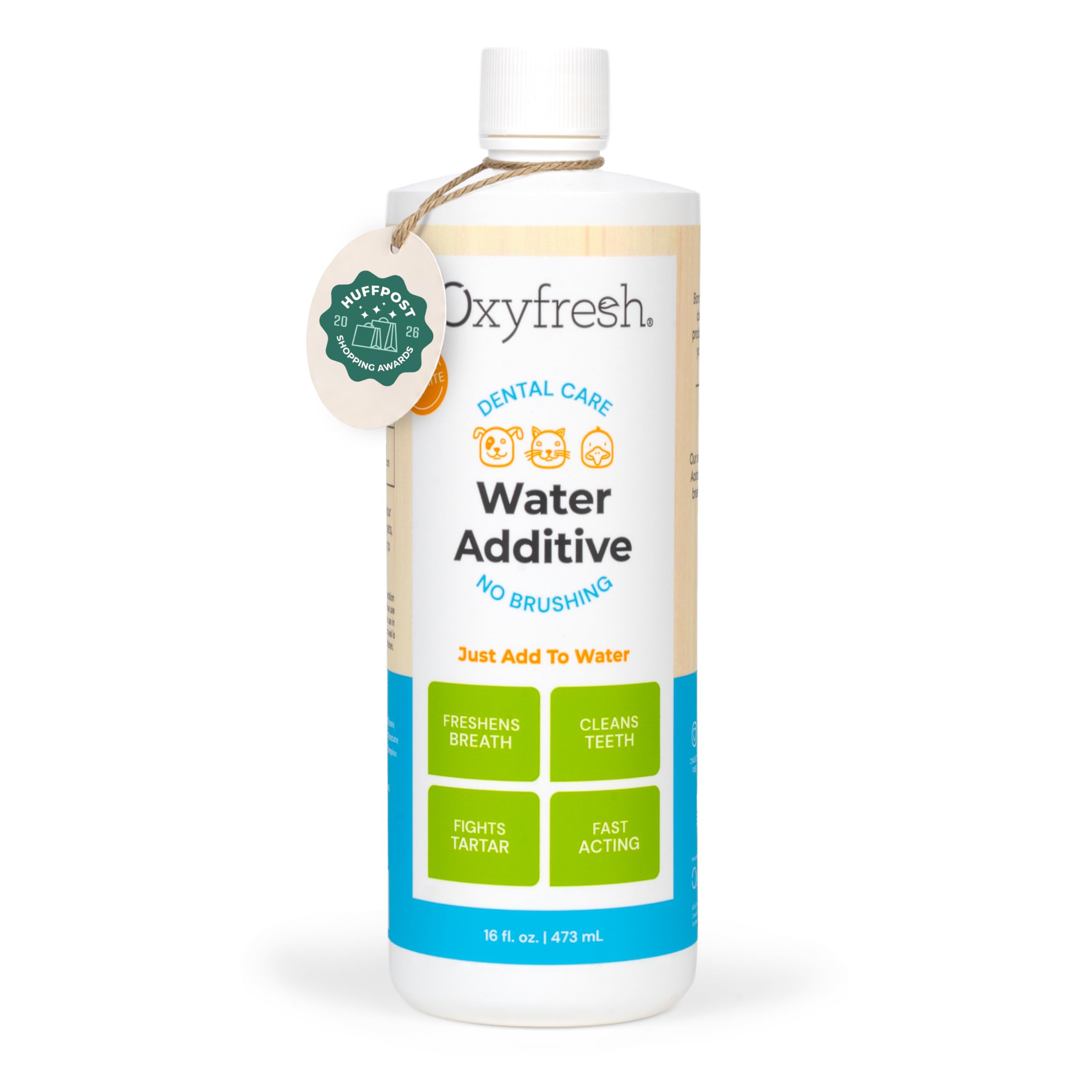
Oxyfresh Premium Dental Water Additive

Oxyfresh Premium Dental Water Additive

Everyday cat households

Our Score 8.6/10
Check Price

Worth Noting

  • Stomach upset in some cats when first added
Dose
One capful per bowl daily
Pets
Cats and dogs
Formula
Flavor free, no mint or tea tree
Bottle Size
16 fl oz
Read the full review

Mint and tea tree oil are the two things to keep out of a cat's water bowl, and Oxyfresh is the formula here that names both as exclusions. That detail decided this pick for us. Plenty of dental additives lean on a minty clean sensation to sell themselves, and for a cat that scent is a reason to stop drinking. This one goes in clear and unscented, so the bowl looks the way it did before.

Daily use is a capful in the water, aimed at plaque, tartar, and breath. We appreciate that the dose needs nothing but the cap — no pump to prime, no teaspoon to wash afterward. Sixteen ounces is an easy size to live with, big enough that a one-cat house isn't reordering constantly and small enough for a cabinet shelf, and the formula is labeled for cats and dogs, so a mixed household can run a single bottle.

None of that would matter if cats refused to drink it, and acceptance is where this one is strongest of the group: nothing in the water gives the additive away. For a first water additive, or for a cat that has already turned its nose up at something else, it's the balance we want — an exclusion list that suits cats, a dose a person will keep up with, and no smell to raise suspicion.

Bottom line: The one we point cat owners to first: flavorless, free of mint and tea tree, and dosed with a capful. It's the safest default unless your cat has a sensitive stomach.

4

TropiClean Fresh Breath for Cats

TropiClean Fresh Breath for Cats

Cat-only homes

Our Score 8.6/10
Check Price

Worth Noting

  • Some cats refuse the treated water
  • Not as neutral as the tasteless claim suggests
Made For
Cats only
Bottle Size
16 fl oz
Starting Dose
Half the label amount
Claimed Freshness
Up to 12 hours
Read the full review

Every other pick in this guide is labeled for cats and dogs. TropiClean's is not: it's a cat formula in a sixteen-ounce bottle, with label claims of fresher breath lasting up to twelve hours and plaque and tartar reduction in fourteen days or less. In a house with no dogs, that specificity is worth something — you aren't buying a product aimed at a different animal and hoping.

It's also the only bottle here that tells you to start below the label dose. Cats with sensitive stomachs, or cats new to the product, begin at half the recommended amount. That's sensible advice for any additive and rare to see printed, and it tells you the manufacturer expects some cats to notice the change.

Foam is the thing to plan for. In a fountain, the additive bubbles where the falling water hits the surface, and a cat that was happy with the fountain can go looking for the tap instead. A plain ceramic bowl sidesteps it entirely. The bottle also sits at the budget end of this group, which makes a cat-specific formula a small commitment to try.

Bottom line: The only bottle here made for cats alone, with a gentler starting dose for sensitive stomachs — best suited to a plain bowl rather than a fountain.

5

Dental Fresh Advanced Water Additive

Dental Fresh Advanced Water Additive

Multi-cat households

Our Score 8.6/10
Check Price

Worth Noting

  • Stomach upset in some pets
Dose
Built-in measuring cap
Pets
Cats and dogs
Formula
Flavorless and scent-free, no sugar
Bottle Size
32 fl oz
Read the full review

Thirty-two ounces is the largest bottle in this guide, and for some households that ends the discussion. Dental Fresh builds the measure into the package too: the cap doubles as the dosing cup, so filling three bowls is one pour rather than three guesses.

In a multi-cat house this is the practical pick, and not only because of the size. The formula is flavorless and scent-free with no sugar or artificial flavors, aimed at plaque and the odor-causing buildup behind it, and nothing about it requires a scoop or syringe living on the counter. The bottle is the whole kit.

One caveat: the scent-free claim isn't unanimous. There are noses that pick up something in the bottle the label doesn't prepare them for, even when the water itself goes unremarked. It's the kind of thing a fussy cat notices before you do.

Bottom line: Thirty-two ounces with a measuring cap built into the bottle — the one we point to when there's more than one bowl to fill and you don't want to ration doses.

6

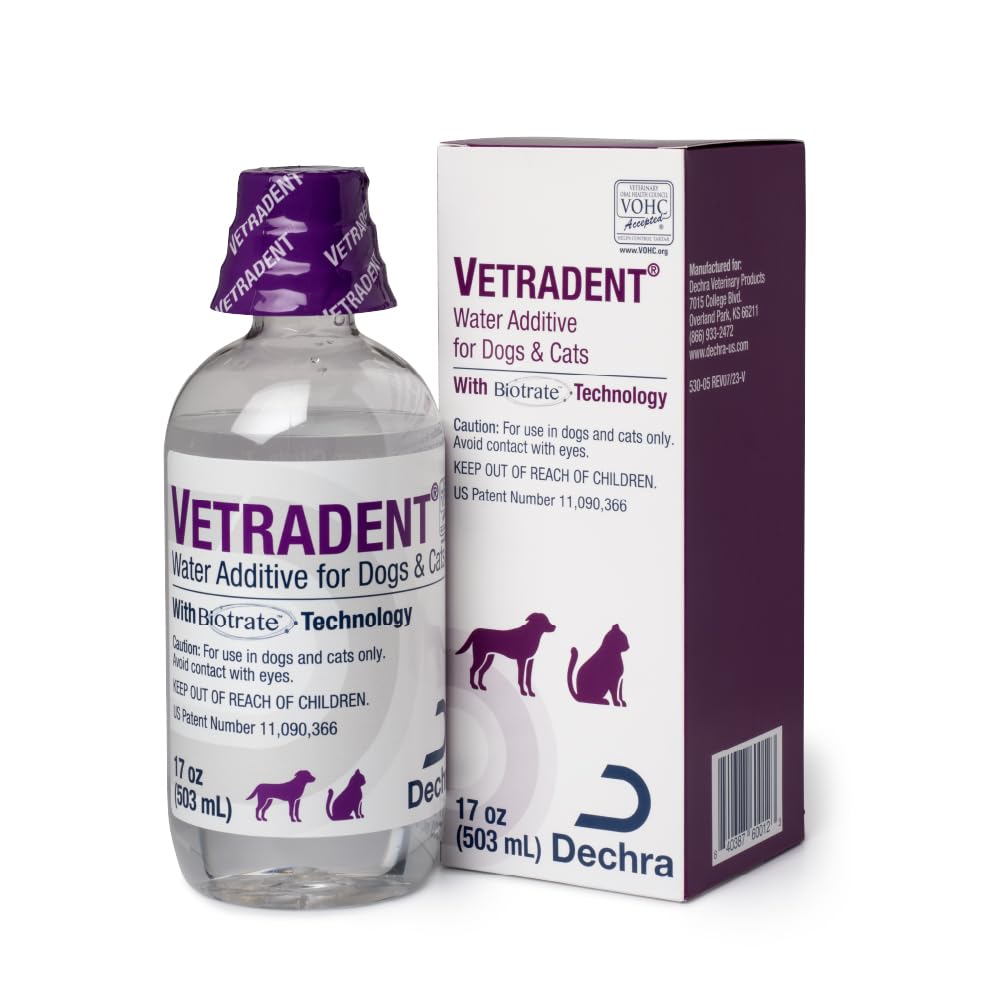
VETRADENT Water Additive

VETRADENT Water Additive

Measured dosing

Our Score 8.4/10
Check Price

Worth Noting

  • Some cats refuse the treated water
Dose
2 tsp per cup of water
Pets
Cats and dogs
Bottle Size
17 fl oz
Read the full review

Two teaspoons per cup of water: VETRADENT prints the ratio on the measuring cap, along with a chart for one, two, and three cups, and asks you to shake the bottle first. That's more instruction than any other bottle here gives, and for something you pour into drinking water, precision isn't a small thing.

It's a clear liquid from a veterinary products company, aimed at reducing tartar and maintaining dental hygiene, and it's labeled for dogs and cats. Seventeen ounces sits in the middle of this group on size.

The ratio is what we like about it. This is the only bottle here that scales the dose to the volume of water rather than to the bowl — a small bowl gets two teaspoons, a bigger one gets four — so the dose stays right when you change bowl sizes. The arithmetic also tells you what to expect: seventeen ounces covers roughly fifty cups of treated water.

That makes it the budget bottle with the most rigorous directions, and the one to choose if measuring by ratio suits you better than a capful.

Bottom line: The most explicit dosing here — two teaspoons per cup of water, printed on the cap — from a veterinary brand, at the budget end of the group.

How We Tested the Best Cat Dental Water Additives

We started by rounding up every additive we could find that was labeled for cats, then read the ingredient panels and set aside anything alcohol-based or containing xylitol, since in plenty of homes the dog drinks from the cat's bowl too. From there we filtered by cost per dose, whether the bottle had a dropper marked in clear increments, and whether the liquid itself was genuinely odorless — a bowl that smells like mint is a bowl a cat walks away from. Fourteen made the cut.

Each additive got its own stretch in a marked bowl in a real kitchen, with water levels checked morning and night so we could see how much was actually disappearing. We noted whether it mixed in clear or left the water cloudy, whether anything settled to the bottom by evening, and whether cats showed up at their usual times or sniffed and left. For the first few days of every trial we also tracked appetite, drooling, and litter box changes, because an additive that quietly upsets a stomach is not a mild problem.

Functionality got checked at every refill: whether the dropper dripped cleanly or overshot the dose, whether the liquid left a film on the bowl or a slimy ring in a fountain, and how many days a bottle lasted at the label dose, which is the only honest way to know what you're spending per month. In multi-pet households we watched whether the dog emptied the cat's bowl — several did — and we had a vet tech look at gumlines at the start and end of each trial so breath wasn't our only measure.

How to Choose Cat Dental Water Additives

Dosing Is a Habit Before It's a Formula

These bottles dose four different ways: a capful poured into the bowl, a pump that delivers a fixed squirt, a teaspoon measured against cups of water, and drops. The method decides whether you keep the routine going. A capful takes no equipment but is a blunt measure for a small bowl; a pump gives the same amount every time; a ratio dose scales correctly when you swap bowl sizes.

Think about how many bowls you fill and how big they are. Single small bowl, once a day: a capful or a pump is plenty. Several bowls, or bowls you change size for, and a ratio or cap measure saves you guesswork.

Check What Isn't in the Bottle

Cats are not small dogs when it comes to what goes in their water. Mint and tea tree oil are the two ingredients to screen out, which is why the Oxyfresh bottle leads this guide: it names both as exclusions rather than using them to sell a clean feeling.

Treat a flavorless claim as a claim. If the bottle has a scent when you open it, assume your cat can smell it too, because it can. Read the ingredient line before the marketing copy, and put the bottle back if the first three words are a flavor.

Size the Bottle to the Number of Bowls

Bottles here run from a one-ounce dropper to thirty-two ounces, and the right one depends on how much water you treat in a day. A single cat with one bowl gets through a small bottle quickly enough that a big one just takes up cabinet space; three cats and a fountain drain the big bottle without waste.

Judge cost per use rather than the number on the shelf tag. A drops-based bottle looks expensive and lasts months; a large bottle looks like value and disappears fast if you are filling four bowls twice a day.

What a Water Additive Can and Can't Do

These products are maintenance. They support breath and slow new plaque and tartar, and they are worth having for a cat that will not tolerate a toothbrush. They do not replace brushing, and they do not remove what has already hardened onto the tooth.

Give a new additive about a week before you judge it, and watch the litter box as closely as the breath. If stomach upset appears, stop. A cat with a painful mouth, bleeding gums, or a sudden change in eating needs a veterinarian, not another capful.

Frequently Asked Questions

Final Verdict

Oxyfresh Premium is the bottle we point most people to: flavorless, free of mint and tea tree, dosed with a capful, and sold in a size that fits an ordinary household. It is the least fussy way to start, and the least likely to make a cat suspicious of its own bowl.

If you want a bottle made for cats alone, TropiClean is the one, as long as the water goes in a bowl rather than a fountain. And if three cats share three bowls, Dental Fresh's thirty-two ounces and measuring cap will cut the refilling.